The Oxford Inn
An Account of no. 14, Vaughan Street and its Occupiers
By Lyn John
While builders were carrying out alterations to an empty shop at number 14, VaughanWStreet, Llanelli, evidence was discovered of what appeared to be the cellar of an inn or public house. Interestingly, the work (carried out c.2022) was to convert the betting shop property into a new public house, and local interest was aroused as to the name of the former inn. The earliest record of Vaughan Street, Llanelly, was a planning application in the Western Mail in 1863. [1] This was about the time that the street was being developed from the gardens of Llanelly House. Listed in Vaughan Street in the various trade directories of the period were the Gate Hotel, the Northgate Hotel, the Oxford Inn and a wine shop. To the author's personal knowledge, the Northgate Hotel used to stand on the Stepney Street corner of Vaughan Street. The
Census of 1871 shows the Oxford Inn as being the best candidate to match the site that is now 14, Vaughan Street, and the recent discovery of a beer cellar there points to its being in fact the site of the former Oxford Inn. In 1870, the Western Mail mentioned the inn in an assault case ...
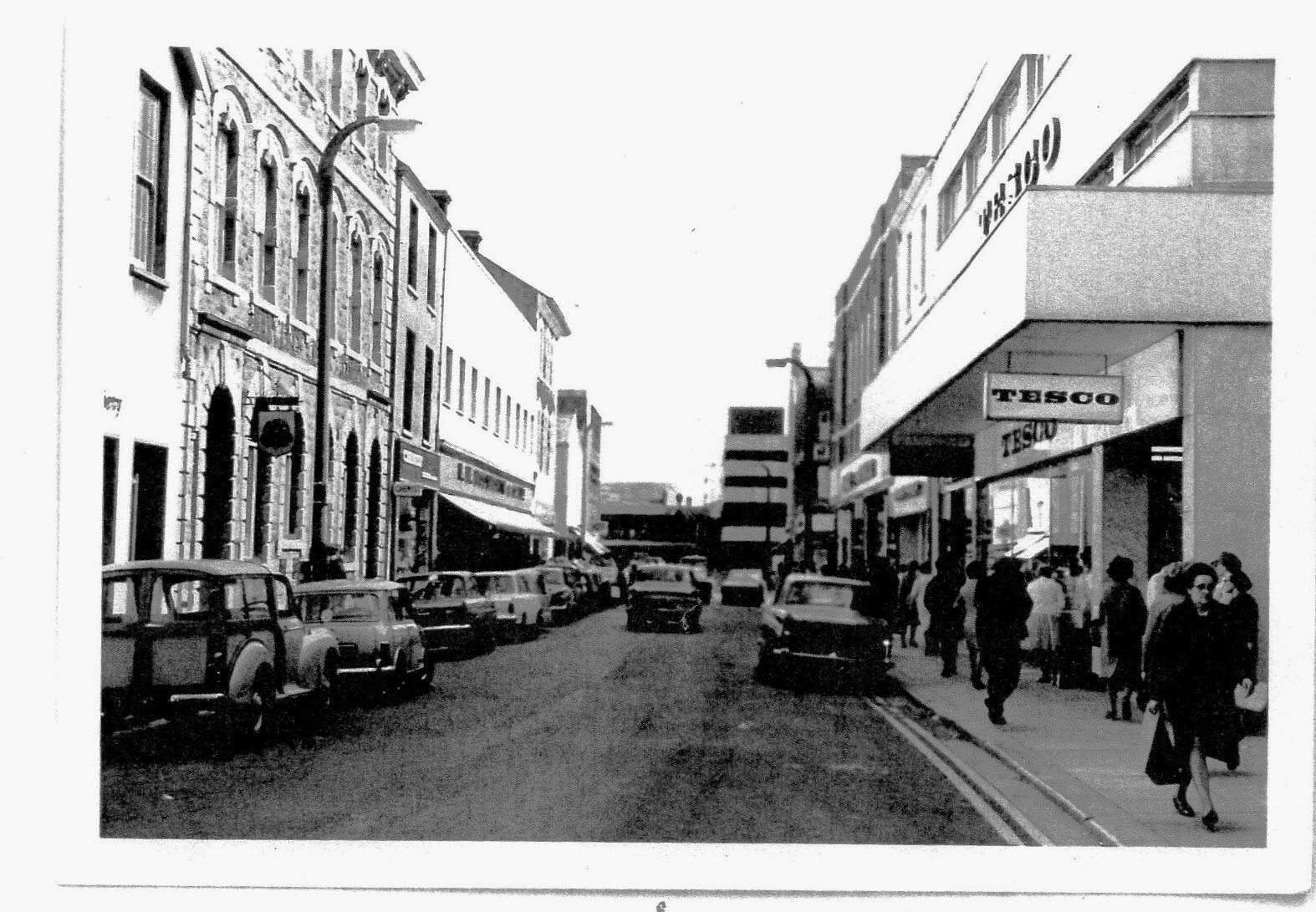
Oxford Inn, Vaughn Street, Llanelli
________________________________________________________________________________
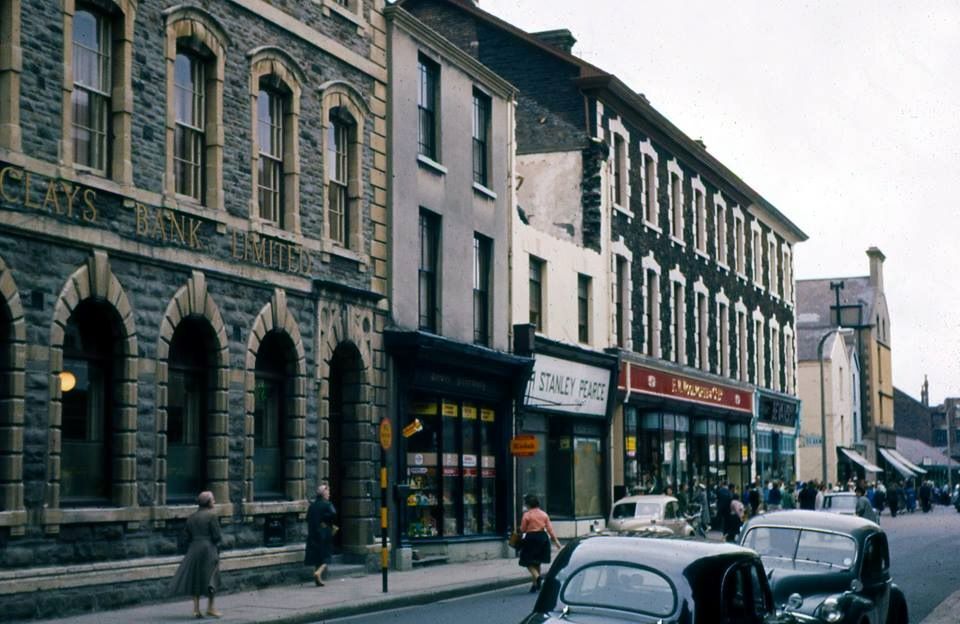
Oxford Inn, Vaughn Street, Llanelli 1950's (Doug Simpson) ________________________________________________________________________________
In 1870, the Western Mail mentioned the inn in an assault case ...
"Thomas Henry Bowen, Murray-street, was charged by William Duggan, Union
Square, with assaulting him on the 23rd ult., at the Oxford Inn, and cutting his lip open.
Plaintiff and Mr. Thomas Harries, chemist, who had dressed [the] wound, were examined,
and the case was adjourned to the 20th inst." [2]
The 1871 Census shows Joseph Braithwaite Hopkins, an innkeeper, along with his wife
Caroline, and three children living there, but who was Joseph Braithwaite Hopkins? He
was born and christened in Llannon in 1831, his parents being Morgan and Maria Hopkins.
At the time, his father’s occupation or standing was described as “Gent”.
By 1861 Joseph had moved to Llanelly and was listed as a “Landed Proprietor” living in
Felinfoel Road, near to the Mount Pleasant Inn. Had Joseph inherited his parents 'property
or assets and used them as an investment for a future home in the town, a town that was
fast growing as the Llanelly House gardens were being developed into a new market town
and shopping centre?
In 1872 a local trade directory states that the inn was licensed to John Williams.[3] It is
possible that John Williams was a tenant of Joseph Braithwaite Hopkins, or was he
licensed and employed by him?
The following year the inn was again mentioned in the newspaper in a case of theft, when
Richard Clarke was accused of stealing a watch, chain and locket. "John Palmer,
Llanelly, labourer, charged Richard Clarke, Llanelly, tailor, with stealing a watch, chain,
and locket, on Tuesday last. It appears that complainant and the defendant were at the
smith's forge in Thomas-street on Tuesday last; at that time the complainant had his watch
and chain in his pocket. The defendant em-braced him once or twice; they went to have
some drink, and upon someone asking the time, he found that his watch, &c., were gone.
He went to the Oxford Inn, and found that the prisoner had been offering the chain and
locket there. It was a brass chain and locket, and the complainant stated in court that he
would not give a shilling for them; the watch was worth £2. P.C. William Davies
apprehended the prisoner at Mr Freedman's pawnshop in Water-street, where prisoner went
to know how many carat grain the chain was. The police, who been there before him, was
sent for. Prisoner said he was given the chain to sell by plaintiff, but the plaintiff denied it.
The watch has not ' been found.--Prisoner was afterwards charged with stealing a shirt, the
property of Thomas Richards, who keeps the Three Horse Shoes Inn and smith's forge,
which he had pawned for Is 6d. He was committed for three months—six weeks for each
offence.2"[4]
By 1881 Joseph Braithwaite Hopkins was 49 years old and was still living in the Oxford
Inn but by then he was described as being “out of business”. It is possible that he had
retired, and it appears that he and his family had a young servant girl living with them.[5]
Six years later, Joseph died at the age of 56 and was buried in Felinfoel Church Cemetery
on 12
th December 1887.[6]
In 1889 the Welshman newspaper advertised the premises as a chemist shop operating
under Sam R. Harry. According to newspaper reports, Sam Harry was the son of William
Harry, a local surveyor, and was married to a wealthy London lady. She may have financed
the young chemist to convert 14, Vaughan Street from a public house into a chemist's
dispensary.[7] This was an important milestone for the property as it started a century of
use as a chemist shop.
In may 1890 Sam Harry suffered an embarrassing report in the local press having being
charged with others, for gambling and drinking in the Stepney Arms Hotel. Sam and his
eminent friends, including John Morgan, Aron Stone, a local ship broker, and George
Watkeys, the local Town Surveyor. All were cleared of the charges as being “not proven”.
[8]
Two years later the business was listed as employing an apprentice by the name of
William Watkins who, by 1895 had taken over the chemist shop. Unfortunately for
William, illness forced him into bankruptcy in the middle of that year. [9]
Sam Harry died in 1899 of pneumonia following a bout of influenza. The property was
then used as a chemist, dentist and druggist’s business by Alfred Rogers and continued to
be used as a chemist’s for nearly a century.
Here is a list of the some of the other occupiers ...
J Gower Chemist licensed to sell alcohol medicine
Morris & Evans
Lewis Morris
In later years, 14 Vaughan Street was occupied by Coral, one of a chain of betting shops
until it closed circa, March 2022.[10]
Following a short unoccupied period, the building has experienced a revival as the
appropriately named Tin House, a public house, tap room and restaurant which celebrated
its official opening on 16 th March 2023.
________________________________________
[1] Western Mail 7 August 1863
[2] Western Mail 8 July 1870
[3] Chalender’s Directory 1872
[4] Welshman 27 June 1873. P5 C1
[5] 1881 Census
[6] South Wales Press 15 Dec 1887. Church Burial records
[7] South Wales Press 10 Aug 1899 Obit
[8] Llanelly Guardian 1 May 1890.
[9] 1891 Census. 15 August 1895 Western Mail p7
[10] Numerous Trade Directories and Census Returns appertaining to Llanelli.
Illustration: Vaughan