Llanelly Royal Prize Choir and their USA Tour of 1909-10
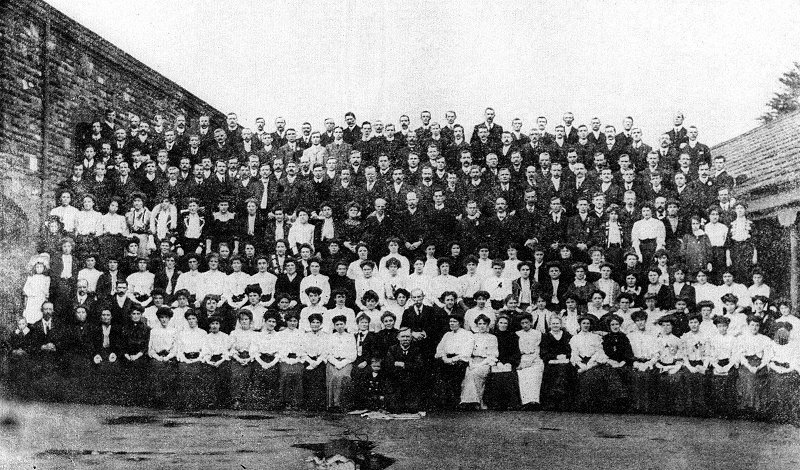
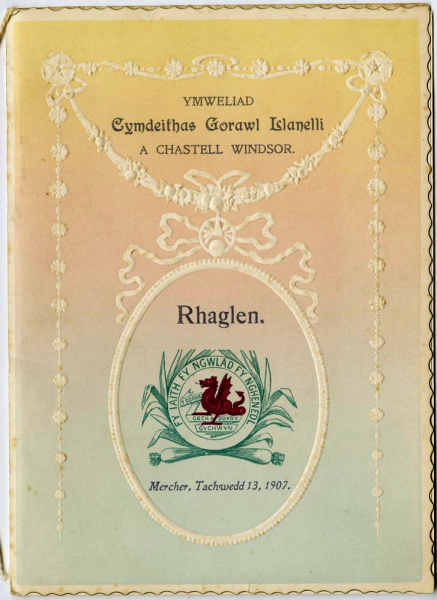 Many of us of Llanelli stock have great-grandparents or their siblings or cousins, who sang with the legendary 230-strong Llanelly Choral Society, when they performed at Windsor Castle for King Edward VII, Queen Alexandra, and the King’s cousin Kaiser Wilhelm II and Kaiserin Augusta Victoria, on the night of Wednesday 13th November, 1907. There may be 230 copies of the programme and itinerary still treasured by families, along with the commemorative gold medals. Following this Command Performance, the Choral Society was known as the Llanelly Royal Choir. Maybe a few, like me, also have an ancestor who made the gruelling but exciting tour of the United States of America undertaken by a smaller group of singers leaving Llanelly in September 1909 and not returning until April 1910. This article is a snapshotof that adventure, written from a mix of family stories and research.
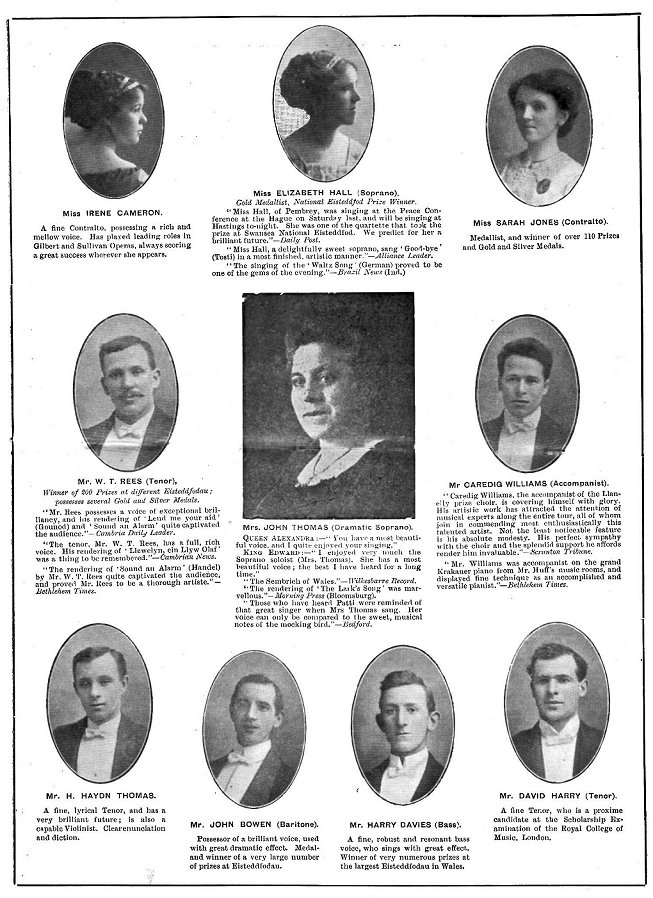
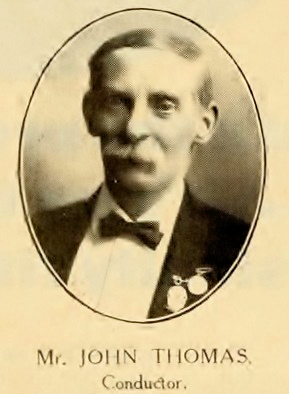 The small concert party that crossed the Atlantic and sang their hearts out for over seven months was known as the Llanelly Royal Prize Choir. Under the leadership of choirmaster John Thomas it was made up of a selection of the Choral Society’s best singers, described by the Llanelly Mercury newspaper as all being of soloist quality; my great-grandfather Gwilym Phillips, at 44 years of age was one of the oldest to travel. He was a Tin Man at The Old Castle Tinplate Works, a Committee member of the Choral Society and one of the First Basses. In addition to the members of the Llanelly Royal Choir, four professional singers were added, namely Pwll’s outstanding baritone David Brazell, William T. Rees of Pontarddulais and Tydfil Brown, a gifted young contralto, whose parents had left Merthyr Tydfil and settled in Shawnee, Oklahoma. John Thomas’ wife Sarah Jane, known professionally as Madam John Thomas, was well-known throughout Wales and had previously toured South Africa and America as a soloist. The party also included their son Harry Haydn Thomas and John Thomas' younger brother David Thomas.
Across the Atlantic
After a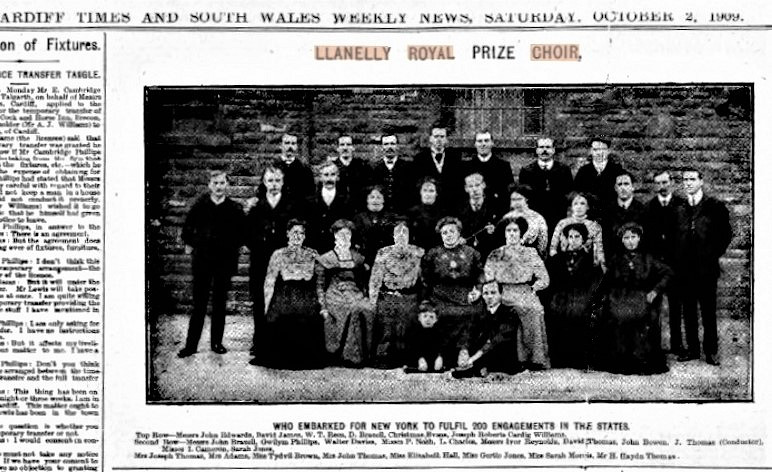 short summer tour of Wales, the choir gave an enthusiastically received farewell concert at the Market Hall, Llanelly on 20th September 1909 before sailing from Liverpool aboard the White Star Line’s RMS Baltic on 25th September, arriving in New York on 3rd October. Their families were not to see them again until they docked at Fishguard on 13th April 1910 aboard RMS Campania the transatlantic flagship of the Cunard Line, at one time the largest ship in the world. The Baltic's Manifest of Alien Passengers for the outward voyage lists the following choir members:
| MEMBER | AGE | PROFESSION | NEXT OF KIN | |
| Polly Nash (single) | 21 | Vocalist | James Nash, father | |
| Sarah Jones (s) | 21 | Vocalist | John Jones, Llewellyn St, Llanelly | |
| Sarah Morris (s) | 27 | Vocalist | Thomas Morris, 45 Dillwyn St | |
| Irene Cameron (s) | 21 | Teacher | John Cameron, father, Llanelly | |
| Lettice Charles | 18 | Dressmaker | D. Charles, father | |
| Gertrude Jones | 21 | Teacher | D. Jones, father, 46 High Street | |
| Claudia Adams (m) | 45 | Keir Adams, College Hill, Llanelly | ||
| Lizzie Thomas (married) | 42 | James Thomas | ||
| William Thomas Rees | 29 | Merchant | Elizabeth Rees, Pontarddulais | |
| Caredig Williams | 28 | Professor | Kate Williams, mother, Llangennech | |
| Ivor Reynolds | 28 | Clothier | Geo Reynolds, father, Llanelly | |
| Christmas Evans | 24 | Ironmonger | Geo Evans, father, Llanelly | |
| John Thomas | 49 | Stationer | 20, Station Road, Llanelly | |
| Mrs Sarah Jane Thomas | 47 | 20, Station Road, Llanelly | ||
| Thomas Thomas | 28 | Tinplater | Catherine Thomas, wife, Llanelly | |
| Gwilym Phillips | 44 | Tinplater | Mary Jane Phillips, wife 6 Marble Hall Rd, Llanelly | |
| Joseph Roberts | 40 | Jeweller | Annie Roberts, wife, Nevill Street, Llanelly | |
| Walter Davies | 49 | Rlwy Foreman | Mary Davies, wife, Nelson Terrace, Llanelly | |
| John Edwards | 22 | Tinplater | Sarah Edwards, wife, Burry Street, Llanelly | |
| David James | 54 | Tinplater | Ann James, wife, Dolau Rd, Llanelly | |
| David Brazell | 20 | Vocalist | Mary Brazell, mother, Pwll, Llanelly | |
| John Brazell | 26 | Tin Worker | Mary Brazell, wife. 72 Pembrey Rd, Llanelly | |
| David Thomas | 27 | Sculptor | Jane Thomas, wife, 4 Princess St, Llanelly | |
| Harry Haydon | 19 | Sculptor | John Thomas, father, 20 Station Rd, Llanelly | |
| Elizabeth Hall | 25 | Vocalist | Margaret Hall, mother, Pembrey | |
| Tydfil Brown | 21 | Vocalist | Morgan T Jones, uncle, Llanilar, Aberystwyth | |
It is remarkable that the choir members were able to set out on a seven-month trip overseas with the full blessings of their families and employers, the working men were apparently granted an unpaid sabbatical, all in the cause of spreading the reputation of Welsh choral music. Their only source of income during the tour came from the American-Welsh communities for whom they performed, who generously provided warm beds, good food and Welsh conversation, and made sure the post-concert collection plates were full, often topped up by very sizeable donations from successful Welsh ex-pats in the bigger cities. However, John Thomas writes in the South Wales Press later during the tour that the choristers were contracted to pay their own return fare home. It appears that the generosity of the Welsh-Americans donated enough money to maintain the families back home, as in the case of my great grandfather, who sent US dollars home to his wife Mary Jane for the care of their young family, son Nat and daughters Elsie and Evelyn (my grandmother). Imagine those dollar bills being exchanged in the banks of Llanelly!
New York and the White House
The Choir gave the first of three scheduled concerts on arrival in New York in Brooklyn during the first days of October 1909. They also performed on the 42nd floor of the tallest building in the world at the time, owned by the Metropolitan Insurance Co whose owner had connections with a well-known member of New York’s Welsh community, Mr W R Hughes, before leaving the city two days later for performances throughout the state of Pennsylvania.
The highlight of the tour must surely have been 12th November 1909, when the choir performed for President Taft at the White House, although it does not seem to have been singled out in any great detail in Llanelly newspaper reports, other than that they gave a good concert and were given a tour of the White House. Perhaps after the Choir’s experience at Windsor Castle in 1907, the White House may have paled into insignificance?
The Llanelly South Wales Press newspaper published regular lengthy letters from John Thomas under the title of ‘Our Choir on Tour’. He wrote vivid descriptions as the choir made their way around the eastern states of America, mainly naming the Llanelly-born people they met, but also full of praise for the generous hospitality they received from their hosts and how the Choir performed ‘magnificently’. Several other Llanelly papers such as the Mercury carried regular reports and published syndicated extracts from American papers, including ‘The Druid‘, the newspaper of the Welsh-Americans, describing the progress of the tour and reporting many of the concerts in detail.
‘The Druid’ was consistently lavish in its praise “they are being universally claimed as the best party that ever crossed the ocean”. The ‘Scranton Republican’ declared in October that “the singing of the members of this mixed chorus was simply wonderful and no other words express it adequately”. The local paper in Hazelton, Pennsylvania, the ‘Daily Standard’ wrote, “The programme from beginning to end was one of excellence. Their harmonies were beautifully clear and distinct, balance of parts entirely satisfactory, enunciation and articulation of the choir simply perfect, both in the delicate dainty part-songs and also in their heavy chorus work”. Hardly surprisingly, the choir were begged for return visits from enthusiastic audiences.
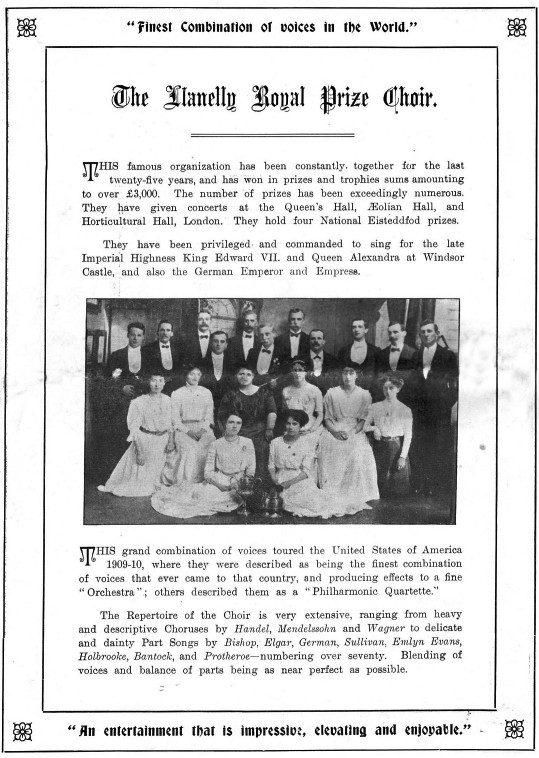
They gave over two hundred performances during the tour - a staggering total that certainly demonstrates the professional standard of their voices, not to mention their remarkable stamina; even on their return visit to Pennsylvania in March 1910, they performed fourteen concerts in four days in Pittsburgh. They often gave four performances a day, rising early in the morning to travel by railroad to their next destination before the sun was up, shipped from railroad stations to concert venues in horse-drawn buggies, horse-drawn sleighs in winter, and occasionally in fleets of motor cars.
From Pennsylvania to Wisconsin
Pennsylvania and Ohio were the US states with the highest Welsh populations; many towns such as Youngstown and Scranton, had strong historic links to the Llanelly area, but the choir also spread their musicianship across thousands of miles in towns and settlements across Virginia, West Virginia, Washington DC, Indiana, Kentucky, Wisconsin, Illinois and Massachusetts, often performing before huge audiences - audiences over 1200 were not unusual. News reports said that they performed in front of over 1600 people in many cities, in venues as diverse as schools, city opera houses, Episcopal churches, Welsh chapels, the Ohio State Legislature, before an Ohio Miner’s Convention, in towns with no Welsh residents, in an orphanage and even for one hundred prisoners at the Penitentiary in Newark, Ohio.
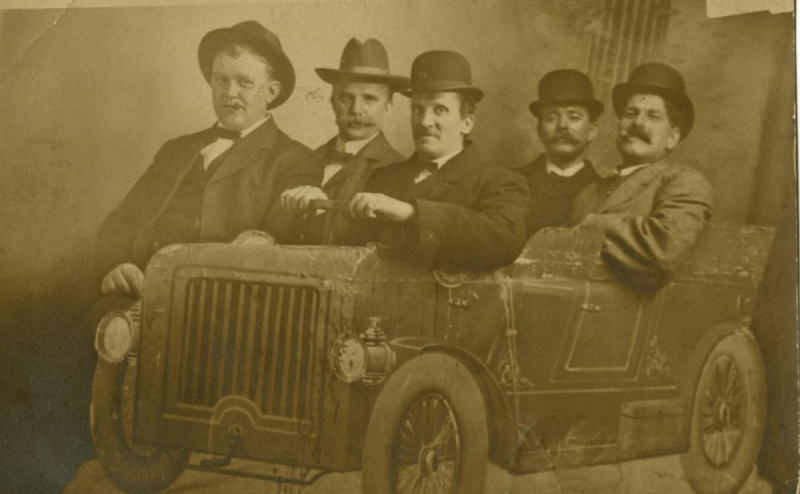 We still have the postcards that Gwilym sent from Randolph, Wisconsin, Terre Haute, Indiana and Cincinnati, Ohio which give us a small window into what they were experiencing - wide boulevards, motor cars and thick winter snow. The choir spent two days over New Year 1910 in Cincinnati, Ohio where Gwilym and four colleagues were photographed in a wooden mock-up of a car in a Cincinnati studio, all looking remarkably serious. There were reports in the Llanelly papers of their adventures, too. In Christmas week 1909, on the way home to their lodgings after a performance at Vaughnsville, Ohio driving themselves in a horse-drawn buggy, John Bowen, Gwilym Phillips and Harry Haydn Thomas got lost in the dark and went to another town all together. Hours later, they stopped to ask at a farm for directions and fortunately found themselves at the right farm. As John Thomas wrote in his column for the South Wales Press, “all trouble ended”.
The choir performed dozens of return concerts, eventually making two hundred and ten performances in all, their original itinerary appearing to have considerable flexibility in order to finance the trip. They met up with family members and Llanelly ex-pats, made countless new friends, saw sights unimaginable to their families back home in the grey, terraced streets of industrial Llanelly. We can only guess how exhausted they must have been by the months of their relentless routine of travelling on those early morning trains, giving morning and afternoon appearances followed by a full concert performance every night, not to mention the hiraeth for home and family.
{modalcontent modal-content-295}
Hiraeth is a Welsh word that has no direct English translation. The University of Wales, Lampeter likens it to a homesickness tinged with grief and sadness over the lost or departed, especially in the context of Wales and Welsh culture. It is a mixture of longing, yearning, nostalgia, wistfulness or an earnest desire for the Wales of the past. Wikipedia
{/modalcontent}
Return to Wales
After almost seven months criss-crossing some fifteen US States, John Thomas cancelled concerts across Tennessee and Maryland and turned down numerous impassioned pleas for return concerts on 6th and 10th April in Pennsylvania and New York. 15. On 4th April 1910, the Llanelly Royal Prize Choir gave their farewell concert in New York City before setting out for home on the RMS Campania.
John Brazell and his brother David did not travel home with the choir because John, the possessor of a sweet tenor had been offered several solo concerts back in Terre Haute, Indiana. Tragically, just a week later, John Brazell, aged twenty-six, died of heart failure during his return voyage aboard the 'Mauretania'. His brother David brought his body back to Wales to be buried in their home village of Pwll.
The Campania arrived at Fishguard Harbour on Wednesday 13th April 1910 in such rough weather that it could not dock safely so the choir had to be transferred by tender, yet another adventure to tell their families, capping off a memorable and successful tour. They arrived home by train that afternoon to a Llanelly Station packed with people who gave them a rapturous welcome.
Postcards and a Return Visit
 Since starting the research for this story in 2014, I have been lucky enough to acquire a postcard of the choir from a New York postcard dealer via eBay. I was delighted to find that it had been sent in April 1909 by a member of the Choir, David Thomas, the brother of John Thomas, who lived at 14, Princess Street, Llanelly, to his friend J. Edgar Evans. A little further research unearthed the information that Edgar Evans had emigrated to Newcastle, Pennsylvania in 1906 and by the time of the tour was acting private secretary to the local Newcastle Works of the American Sheet & Tinplate Co. Another postcard cropped up recently on eBay via a Llanelly seller, a little gem, as it was written by John Thomas to the Editor of the South Wales Guardian saying excitedly that he’d had confirmation of their visit to the White House to sing for the 27th President, William Taft on 12th November 1909.
More information emerged in May 2020 thanks to a professional genealogist researching the family of John Thomas for a client. Maybe due to the resounding success of the USA Tour and the adulation John Thomas and his wife had received personally, they planned to take a smaller party of three tenors, a baritone and one bass, two sopranos, two contraltos and accompanist Caredig Williams on a return visit to the States leaving in October 1911 and returning in 1912. Planning had even progressed to the stage of printing promotional material and I discovered that some of the US newspapers wrote of a forthcoming return visit by the Llanelly Royal Choir. Unfortunately this never happened.
It’s 112 years since those talented Llanelly men and women made that trip across the Atlantic by steamship and travelled thousands of miles by railroad, a trip of a lifetime. I hope this brief description of the tour reaches some of their descendants and sheds some light on the remarkable times experienced by their ancestors.
Notes and Citations
- Voyle/James/Phillips/Thomas Family Archive
- Llanelli Reference Library
- Llanelly Mercury 1907-10
- Llanelly & County Guardian 1907- 10
- The South Wales Press 1909-10
- US Newspapers Online archive via the Ancestry website.
- Mr Phillip Wray
A fuller version of this article appeared in WEA Llanelli’s journal Miscellany/Amrywiaeth No.28, published 2014-15.
See also: Lloyd Street Independent Chapel
©Lisa M Voyle
LCH0379