Shipwreck in the South China Sea
Early in the morning of 18th July 1852 a brig called the Amelia was wrecked after being caught in a typhoon in the South China Sea en route from Singapore to Borneo. The Welshman reported that the survivors and the drowned included several people from Llanelly – but what were they doing so far from home?
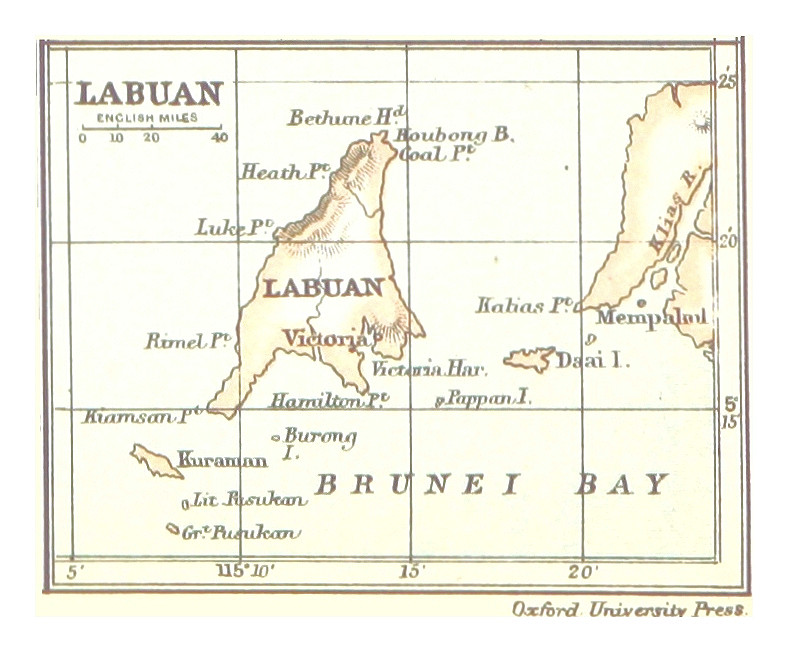 Labuan is a small, triangular-shaped island, six miles off the north-west coast of Borneo, which was ceded to Great Britain by the Sultan of Brunei in 1846. Somewhat surprisingly, this tropical island turned out to have extensive coal deposits and the Eastern Archipelago Company was formed, by royal charter, to exploit them. There were high hopes that coal produced on the island could supply Royal Navy and East India Company ships and even the lucrative South China Sea mail shipping routes.
The Company sent James Motley, a Yorkshireman then living in South Wales, to develop the mining industry at Labuan. James was the son of Thomas Motley, a woolstapler from Leeds who had moved to the Llanelly area and invested in a number of local industries, not least the Dafen Tinworks. Thomas lived with his family in Felinfoel (near the current Diplomat Hotel) and later at Rock House in Pembrey.
Things in Labuan did not go well. The coal seam was deep underground and difficult to access; there were no roads and the island was covered in tropical rainforest, while workers frequently fell sick with malaria. The Company’s mining engineer, Robert Coulson, was not impressed with James Motley’s management of the mines (he wrote to the directors in 1851:”the man we have here pays more attention to the shells, insects and birds”) and recommended that the Company send out “blacksmiths, surveyors, carpenters and enginemen” from Britain to improve working methods on the island. It is possible that James then used his Llanelly connections to find local skilled workers that the Company could rely on.
The chosen party of men travelled by the “overland route”, starting with a subsidised passage on the Peninsular and Oriental Company’s steamer the Bentinck, which left Southampton for Alexandria on 20th May 1852. After a short journey to Cairo on a smaller vessel, the passengers were likely put in horse-pulled carriages and driven the eighty or so miles across the desert to Suez (the Suez Canal wouldn’t be opened until 1869). A contemporary traveller described that desert crossing as “the most horrid journey I ever had in my life”. From Suez they would have sailed down the Red Sea to Aden and then caught another P. & O. steamer to India and then Singapore.
 On 7th July the group left Singapore for Labuan on the Amelia, a 129-ton brig captained by James’s younger brother, Francis Motley. Disaster struck when the ship was caught in a typhoon on the 18th, only 40 miles from their final destination. Francis wrote a first hand account of the shipwreck, published in the Singapore Free Press, where he explains that in the early hours of the morning the wind began to increase “to a squall of the most fearful violence ...the lightning and the rain were tremendous and the sea all white with foam”. Only 12 of the passengers and crew made it into the quarter boat before the ship disappeared below the waves, leaving them “with two oars, out of sight of land, without water, provisions or compass”. After a day’s hard rowing they reached the shore and, with the help of some friendly natives, made it safely to Labuan. The ship’s valuable cargo, mostly uninsured, was also lost.
 The Welshman reported that the survivors included Mr Henry Brodie of Llanelly, and his wife (probably not his actual wife). Henry Brodie was a mineral surveyor and at one point had worked for William Chambers of Llanelly House; his name had been mentioned at the inquest of Mira Turner, the tragic housemaid whose story is featured in the official tour of that house. After the shipwreck, Henry lived for some time in Labuan before escaping an attack by angry natives and, it seems, moving to Australia. James Motley was not so fortunate and was killed, alongside his wife and three children, in a notorious massacre of European settlers in Borneo in 1857, aged only 36.
At least two other Llanelly men drowned in the shipwreck. John Leyshon was a shipbuilder and father of five; his widow Mary later ran the Ty Melyn Inn in Park Street. Rees Evans, a collier, lived in Church Street with his wife and five young children and was the local agent for an early Welsh language newspaper, Seren Cymru. That newspaper’s obituary for Rees describes him as a quiet, kind, peaceful man who had discharged his duties conscientiously.
John Williams, blacksmith, also drowned but an Evan Thomas of Llanelly (likely another collier) survived the shipwreck. Seren Cymru expressed great sympathy for the widows and many children left behind in Llanelli, quoting from Psalm 77: “dy ffordd sy yn y môr, a’th lwybrau yn y dyfroedd mawrion” (“thy way is in the sea and thy paths in the great waters”).
In the end, Labuan’s burgeoning coal mining industry did not live up to expectations and the Eastern Archipelago Company was wound up in 1858. James Motley is now best known for his work in the field of botany, including a book co-authored with his friend Lewis Llewellyn Dillwyn, “Contributions to the Natural History of Labuan and the Adjacent Coasts of Borneo (Volume 1)” (there never was a Volume 2); James provided the field notes and specimens and Dillwyn provided the scientific descriptions (and paid the printing costs). James’s specimens of plants and animals are now held in museums and collections all over Britain. Some think if he had lived longer he could have become as well-known in his field as his near-contemporary Alfred Russel Wallace.
Notes & Citations
- The Welshman 22nd October 1852
- ‘Nineteenth-Century Borneo: A Study in Diplomatic Rivalry’ by Graham Irwin (1955)
- Letter from Robert Coulson to Mr Brown 20th June 1851, included in “Correspondence of The Eastern Archipelago Company presented to the House of Lords” (1853)
- Bell’s Weekly Messenger 24th May 1852
- ‘Mails via the Isthmus of Suez and the Contribution of Lieutenant Thomas Waghorn’ (www.michelhoude.com)
- ‘My wanderings: Being travels in the East in 1846-47, 1850-51 and 1852-53’ by John Gadsby
- Singapore Free Press 13th August 1852
- Seren Cymru 11th November 1852
- ‘James Motley: Life Story of a Collector and Naturalist’ by A. Raymond Walker (Minerva, The Journal of Swansea History 2005 XIII)
LCH0388