Pentip School The Beginning
National School on the Wern 1828-1849
Despite the social pressures of the industrial revolution, the people of Llanelli in the nineteenth century appear to have understood the importance of educating their children. This, at a time when child labour was still common practice. Every penny was needed to put a crust on the table. Llanelly at that time had a population of 8566 [a]. A list included in an inquiry into the state of education in Wales in 1847 [b] names at least twenty schools within the town. Many of these schools were described as being ‘private adventures’, but at the top of the list was the National (Church) School.
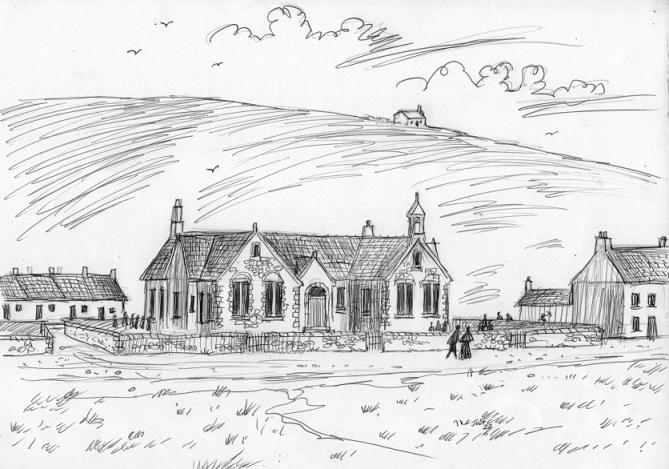 The National Schools were operated under a body founded in 1807 known as the National Society for the Education of the Poor in the Principles of the Established Church. This was, the chief agent for promoting education in England and Wales before the establishment of State School Boards in 1870. National Schools used the Bell’s system of teaching i.e. through monitors or pupil teachers [c].
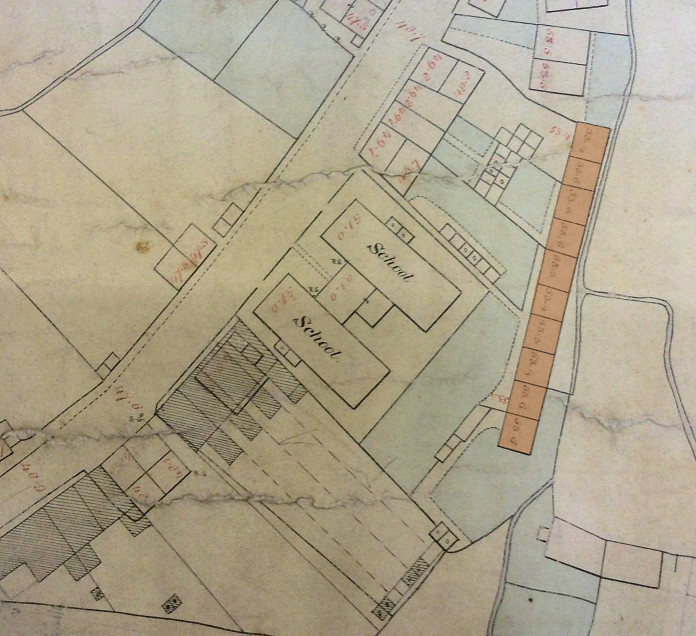
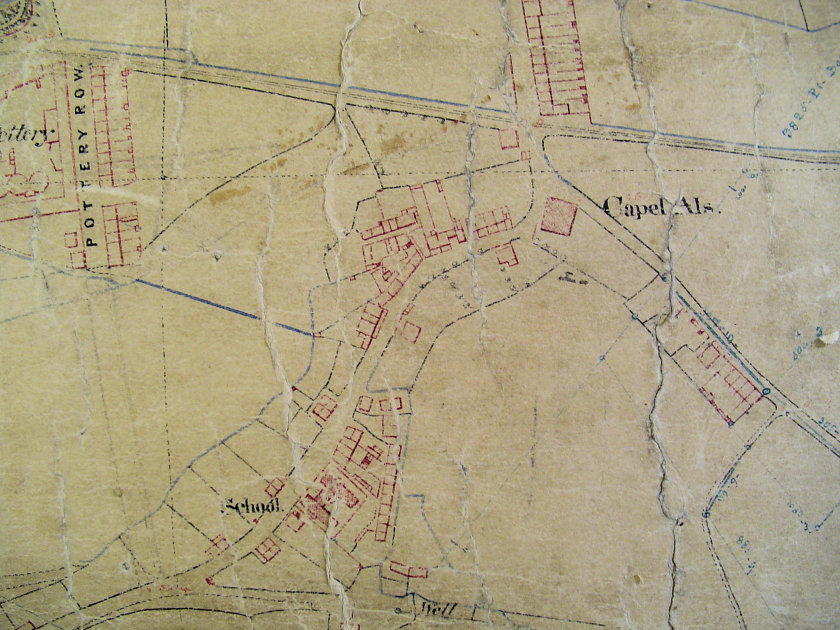
According to Victorian local historian John Innes, the National School in Llanelly was located on the Wern and was completed in 1837 under the auspices of the Revd. Ebenezer Morris. [d] (The Wern is an area to the eastern side of the town at the foot of Bigyn Hill, bounded by Wern Road and Ann Street.) An examination of old plans in Llanelli Library clearly shows the school being adjacent to the town’s old Alms Houses.
There had been an early Fever Hospital next to the Wern National School, which probably consisted of part of the old 'Poor Houses' or 'Alms Houses'. These were taken over by the Llanelly Union Workhouse in May 1848. Their present-day location would be near Court Elusendy. [d] The place is now aptly named Court 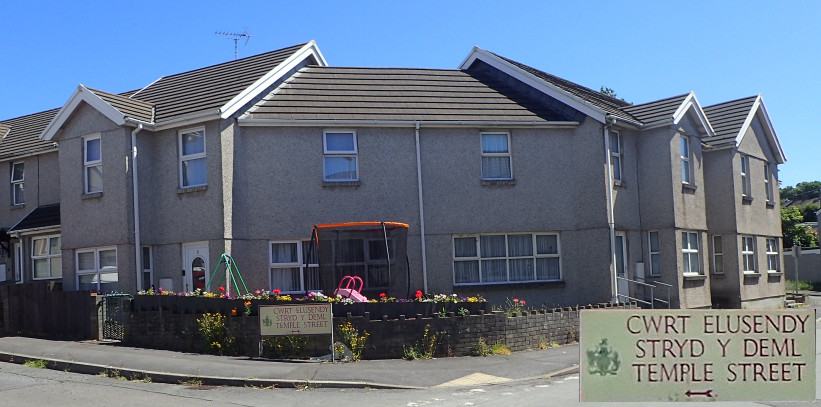 (elusendy = almshouse). This National School had two wings, one for boys and one for girls with a master’s house between. According to Innes, the builders of the school were Mr. John Thomas under Mr. Dai Griffiths "Cold Bath" (Cold Bath was an area in Llanelly) and Davies, the carpenter. The teachers at the school or living in close proximity on the Wern, were Mr. and Mrs. Evans, Mrs. Morgan, Margaret Morgan and David Morris. [e]
A Board of Health contemporary report describes the district of the Wern as being a less than salubrious part of the town forming "… a detached group of 448 houses, built partly in the bottom, and partly upon a hillside, above damp. The drainage is very partial, and the lands above drain upon the cottages.
"At the entrance into Ann-street from the east, there is an open space, upon which the refuse from the small drains empties itself, added to which, the people throw their ashes and refuse upon it.
"At the back of the Wern-row, the lower extremity of the open space, privies and pigsties, without drains, and the fluid escaping along the falling ground, expose a large surface of putrescent matter.
"At the entrance of the Wern Old Colliery there is a heap of ashes on the east side of the road. At the National school and the cottages behind, there are heaps of ashes mixed with excreta, and the whole surrounding premises have heaps of filth dispersed over the surface. The cottages are dirty and filthy, undrained, with stagnant water falling back from the muck in front, upon the very floor of the houses. Generally, throughout, there are no drains to the houses, and at their rear privies and pigsties, which with water oozing along the sides of the walls, present in many places a state of offensive muck, which in many places sap the foundations of the houses and their floors, and manifestly discover their evil tendencies by the squalid and haggard appearances of their inmates."[f]
The National School's chief promoter was the ubiquitous Reverend Ebenezer Morris, Vicar of Llanelly Parish. The school is reported to have had 76 Boys and 49 girls on the books [a] all of whom who were expected to attend his church. Innes said, "On Sundays the boys marched as goats in a solid phalanx to a gallery in the Old Parish Church, while the girls also marched as sheep in a bevy to the same place and occupied the gallery opposite."[d].
In June of 1840 the Cambrian newspaper reported that...
"The principal supporters of this school on Saturday last [were] at the school-room to witness the examination of the children, which did great credit to the master and mistress. The children, 170 in number, were in excellent discipline, and answered the questions on scripture truths with readiness and accuracy, exhibiting considerable knowledge on so important a part of education. Among the company present were Mrs. Chambers, Mrs. Morris, Mrs. Broom, and several other ladies, with the teachers in the Sunday-school, also the Rev. E, Morris, Vicar, the Rev. D Evans, Curate, the Rev. Mr. Richards and several other gentlemen. The Rev E. Morris addressed the children at the close of the examination, and all present seemed much gratified with the proceedings of the day." [g]
Seven years later a government report on the state of education in Wales, paints a slightly different picture of the school...
"I visited this school on the 8th of February [1847]. The building wears a dingy and dilapidated look. The floor is of concrete; damp and broken. The roof is not wholly waterproof. I could see the light through it in places. The master appeared an amiable and intelligent man, but in very ill health. He complained, and not without reason, of the uncomfortable and unhealthy state of his school-room. He is an Englishman, understanding no Welsh. He stated that he found no difficulty from this circumstance, using his monitors, where requisite, as interpreters. This, however, presupposes monitors doctos sermones utriusque linguae * which in many agricultural parts of Wales would not be ready to a master's hand. The scholars are required to attend church on Sundays, but in the day-school no other parts of the Church Catechism are taught than the Lord's Prayer, Creed, and Ten Commandments. The children are removed from school as soon as their labour is worth anything, i.e. at 10 years of age, or soon after. They are sent to school at a very early age. [a]
It used to be accepted that the Wern school was built in 1837 because a stone above the front door of the school house was inscribed with the following; Llanelly Boys National School completed An. Dom 1837. Rev. E. Morris, Vicar [d], but recent research indicates that the school was older by twenty years, as quoted in the above government education report, "the present school was built in 1837 but there has been a National School upwards of twenty years."
By 1848, the very fabric of the school was being literally undermined by the main driver of the town’s industrial revolution – coal! As can be seen in the following circulating letter from the Rev. Ebenezer Morris to the industrialist Richard Janion Nevill...
Dear Sir,
About 20 years ago, two schoolrooms each 60 feet long and 20 feet wide, with a convenient dwelling house for the master and mistress attached were erected in the immediate neighbourhood of the populous town of Llanelly by contributions and assistance from the “the National Society”. This was effected mainly by my own exertions, but I am sorry to say that about 7 years ago owing to the excavations made by the working of coal underneath, the building sustained great injury and at the present time requires thorough repair, the estimated cost of which is £105 and I am particular[ly] anxious to raise this sum without delay as the school is now closed for that purpose. To commence we have £20 already voted towards this object by “the National Society”. Hoping you will aid me in this undertaking and that you will favour me with a reply to this letter. I have the honour to remain your most obedient humble servant.
Ebner Morris
Vicar of Llanelly
Llanelly Vicarage August. 8th 1848.
(Subscriptions may be forwarded to M. Williams Esq., The Treasurer, The Bank, Llanelly.) [h]
Not only does his letter indicate that the school was built circa 1828, but there were problems with the main fabric of the building due to the mining of coal beneath, and so the school was abandoned. In 1849 a visiting school inspector reported on the dilapidated state of the building. The building was subsequently used as a small pottery and was finally demolished circa 1900. [d] [h] [j]
Building a New School - Denominational Friction
Despite Vicar Morris’s attempts to restore the school building, his efforts to secure sufficient money from government grants were in vain, primarily because the Committee of Council on Education were reluctant to provide funds because there was already a sufficient number of schools in the town to meet its the needs, and furthermore, a previous sum of £200 had been ‘squandered’ on the Wern School. There was also deep resentment from the Nonconformists against the setting up of a Church School in the town. Llanelly was already divided by denominational friction: on one side was the Anglican Revd. Ebenezer Morris of the Parish Church, and on the other side the Nonconformist minister David Rees of Capel Als. This religious division became very bitter and resulted in the jailing of two Nonconformists in 1838/40, for ‘declining to act as Churchwardens’. [j]
On 24th and 25th of January, 1860 the leading churchmen and dissenters of the town held a meeting with Her Majesty’s Inspectors, the Revd. H. Longueville Jones and J. Bowstead, Esq., to examine the need for another school in the town. Held at the Ship & Castle, (later the Stepney Hotel). the inquiry turned out unsurprisingly to be divisive. Probably to avoid argument, Mr Bowstead said that he would not allow discussion, but would only hear the cases put to them by the different parties. The churchmen, however, wished to put their case in private because it was clear to them that there were other parties in the meeting who would oppose them. The inspectors declined this request, with the result that several churchmen left the meeting, although Mr R G Thomas, Junior, the Curate. Mr R.T Howell, Mr Glascodine, Mr Roderick, Mr Buckley and other churchmen remained. The Revds. D. Rees, C Spensley, D. M. Evans, R. Perkins, F. Davies and others gave opposing views.
In his opening statement the Revd. H. Longueville Jones read out a long record of the correspondence that had been received on the subject and commented that. "The Treasury had contributed £200 towards the erection of a national School on the Wern which for many years fell into disuse."
By 1860 Vicar Morris was in the sunset of his life: his health was failing, the once giant of a man was described by Innes as " ...having lack-lustre eyes, sitting by the fire in the old vicarage, or wheeled out in a bath chair to the Market or Railway Station, and witnessing, with child-like interest the activity he could no longer share".
He could not fight any more for a new school for the Parish Church.
Despite this setback a new and enthusiastic curate born in Llangathen, circa 1844, the Revd. A.J.M. Green, came to Llanelly and took up the fight. The following report appeared in the local newspaper...[i]
"It is now fully intended to erect a new school here, in connection with the old parish church. The matter has been taken up by the Rev A.J.M. Green, M.A., the senior curate, who has only opened a subscription list since the 5th of September last, and has already succeeded in obtaining the handsome some of £800. Amongst the subscribers we find the names of some of the most influential gentlemen of the town and neighbourhood, including David Lewis Esq., of Stradey, who gave £100 together with a valuable site, Rees Goring Thomas, Esq.,Ferry Side, 100 guineas, Lie. Col Stepney, The Dell, £100. Earl Cawdor, the Lord Lieutenant of the county, £50, the Late D. Morris, MP £50 [k]
A new school was built on the land given by David Lewis, Esq. and opened in 1867.

Notes and Citations
* doctos sermones utriusque linguae = learned words in both languages, in this case Welsh and English
[a] LC2900 (Llanelli Library Collection)
[b] Reports of the Commissioners of inquiry into the state of education in Wales in 1847
[c] The Oxford Dictionary of the Christian Church Edited by F.L.Cross and E A Livingston, Revised second edition page 955
[d] Old Llanelly Innes p 117 and p.135 (LC8966)
[e] The Carmarthenshire Historian, - Llanelli Schools 1800-1870 Vol V p72, 82. by N. Gibbard, and 1841 Census Returns
[f] Report of the general Board of Health 1850 (LC1886)
[g ] The Cambrian 27 June 1840
[h] Nevill Industrial Records now held in the NLW. (Nev Ind 2411)
[i] Llanelly Star- Schools of Old Llanelly 12 Nov 1938 p6
[j] LC3057 Griffiths, Enid Hilary.
[k] The Welshman 18 Nov 1864
LCH0304