Williams the Tailors and Tŷ Gwyn Church
In 1889 the South Wales Press announced the Reign of the Gates Closing. The “gates” the toll gates that once stood on turnpike roads throughout the country, exacting money from travellers for use of the highway. These gates and their associated toll houses had become redundant. Some were demolished, some remained to serve as homes, and some were used for other purposes. One such toll house became the shop of William Williams, a local tailor. [1]
William Williams
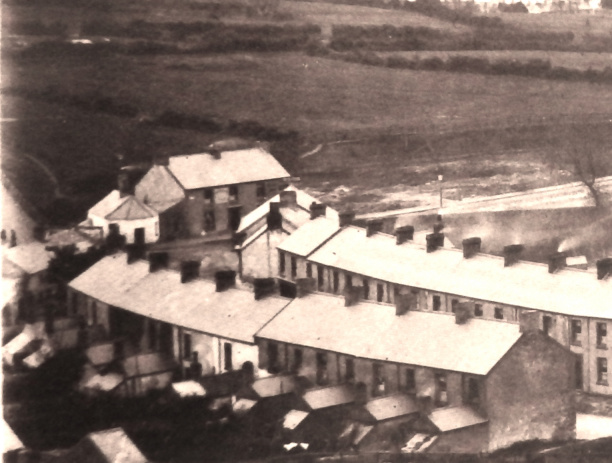 William Williams was born in Llanelly in circa 1874. At the age of 16, William was listed as a Tailor’s Apprentice working for Daniel Davies, a tailors shop in Stepney Street, Llanelli. [2] He must have completed his apprenticeship and set up his own tailoring business by 1900, because an advertisement appeared at the beginning of that year in the Llanelly Mercury promoting Wm Williams Tailor and Draper, Ty-Y-Gate, Furnace, Llanelly [3] Ty-y-Gate, was the redundant toll house standing at the junction of Old Road and Luton Terrace (presently the site of Furnace Post Office).
Its location on the main Llanelly to Carmarthen road was an ideal place to trade from as it was convenient for local customers and those who were travelling to and through into the town to drop off their clothing for repairs and adjustments or for new orders. He must have been well supported because one year later in June 1901 he had opened a shop at Richard Palmer’s old premises in Market Street, next door to the Dot Coffee Tavern, later the Dorothy Cafe.
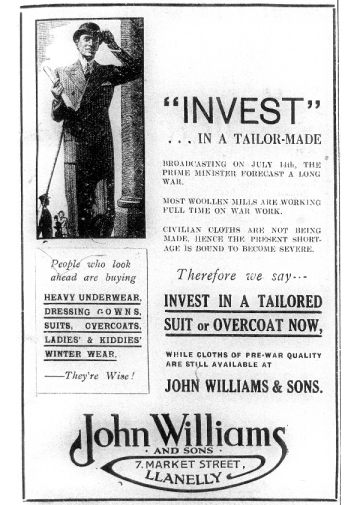 Market Stre
 et was then and for many years, a busy commercial part of the town. William was still advertising his willingness to take orders for the Furnace district from his home in 8 Luton Terrace. One can picture his loyal customers dropping off and picking up their orders at William’s home en route, particularly those not intending to go directly into the town. [4]
Despite the strong competition in Llanelly his business must have been thriving because he was offering his services to both ladies and gentlemen and was operating as Williams and Company, The People’s Tailors. He was also advertising in Welsh…
Ddillad Newydd, Erbyn y Gwyliau, Treiwch WM Williams A’I Gwmni.
By 1905 William and his wife Harriet had moved to Ty Gwyn, in New Road, a large villa with an equally large garden much closer to the town. It had been previously occupied by the Rev. Iona Williams of Park Church. In February of that same year the Llanelly Roads Committee received an application from William Williams to build a chapel in his garden at Ty Gwyn: the building was to be 28ft x 24ft, sufficient to accommodate a hundred people and was to be known as the Ty Gwyn Mission Hall.
An inquisitive newspaper reporter from the Llanelly Mercury called at William Williams' home enquiring what branch of chapel it was to be and William simply answered, "a meeting house". [5] Could this be something to do with the 1904/1905 Welsh Revival? It is interesting to note that both the Ty Gwyn Villa and the new chapel were built on the site of a brewery that was considered “old” in 1853. Very little is known about this brewery.
By 1911 William Williams, the tailor was recorded as "retired" at the young age of 36, although he had to support a wife and five children. His business continued to advertise as Wm. Williams & Co., 5 Market Street. At the same time William was selling religious publications from the Ty Gwyn Mission Hall. He was also advertising "Berean Bible Classes" at the same building where "All Were Welcome". [6]
Although William Williams had retired, probably to pursue his religious activities, the business continued to trade, and advertised as Wm Williams & Co for a number of years, during which time there is mention of a John Williams, probably his brother, who may have been a sleeping partner [7] Despite the First World War, the company continued in business until 1920 when there appeared to be a lull in their trading. It was in that year that Ty Gwyn Villa was put up for sale along with The Freehold Interest in the building at the rear know as “Tygwyn Hall”. The lull in their trading continued until 1923, when in October of that year an advertisement appeared in The Llanelly Star…
Ymlaen 5 Market Street with John Williams & Son, The well tried ladies and gents Tailors.
John Williams
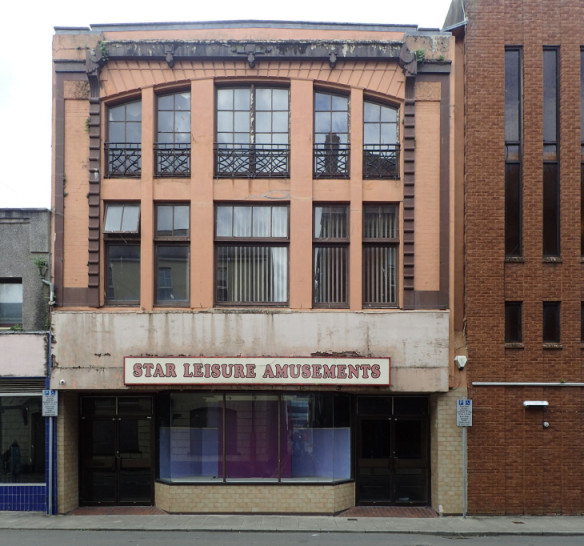
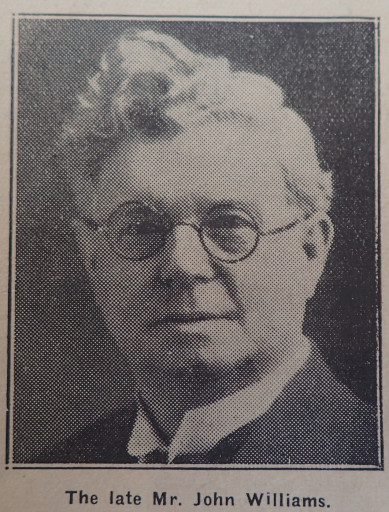 John Williams was born in Llanelly circa 1870 and commenced a career as a tinplate worker in the Western, or Marshfield Works where he was employed for fifteen years in the ‘tinhouse’. Whilst there, he became branch secretary in the trade union. In 1905 he made a career change from ‘tinplate’ to ‘cloth’, becoming a tailor and outfitter. After spending some time in America, he picked up new ideas that inspired him to make major alterations and extensions to the Market Street shop. The shop was extended into the adjacent property, and was transformed with the modernisation of the old Victorian buildings into the new Art Deco style.
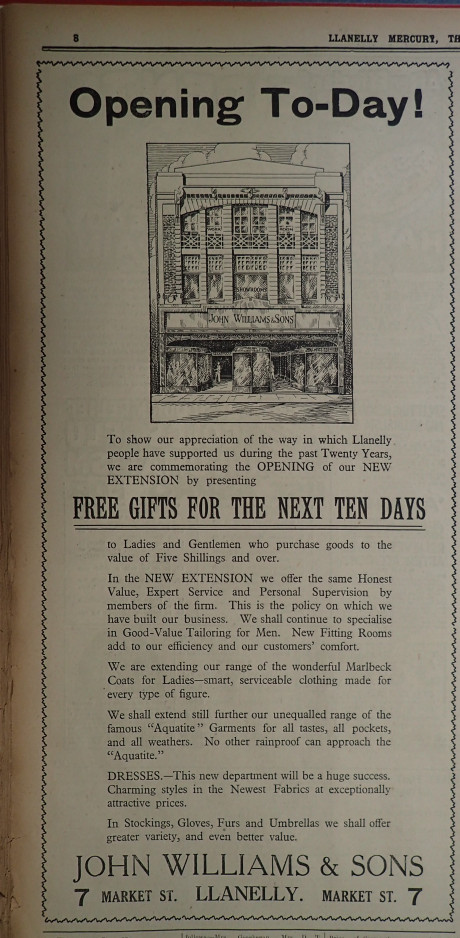 'The ‘thirties’ signalled a new era of building in Llanelly. The new design, fashion and style of Art Deco was taking off. As well as furniture, china, jewellery and clothing, it was also in vogue for architecture. Other buildings followed suit: the Ritz Dance Hall (1934), Burton’s Tailors (1937) and the Odeon Cinema (1938) were all constructed in this style. The new shop, John Williams & Son opened on 3rd April, 1930 with the advertisement …To Show Our Appreciation of The Way In Which Llanelly People Have Supported Us During The Past Twenty Years, We Are Commemorating The Opening of Our New Extension By Presenting Free Gifts! [8]
John Williams & Son gained a reputation as high class tailors and clothiers. catering for both ladies and gentlemen. They were selling clothing of all types including tailored suits and costumes, rainwear, fur coats, gloves, ties, handkerchiefs, socks, shirts, and gifts for men, women and children.
John Williams lived in various houses in Llanelly, naming all of them "Pretoria". In 1901 his home was in Murray Street, and by 1911 in Glenalla Road. He settled there with his wife Laura and raised a family who included Gwladys, Aneurin, Daniel Owen, Ceinwen, and Sarah. Like their father, some of them entered the clothing and tailoring trade. When asked why he called his homes "Pretoria", he replied that it was on the very day he started his business as a tailor that the glad tidings were received from South Africa of the relief of Pretoria during the Boer War. By 1921, the family resided for a time at a house called "Brynyrodin", a large property adjacent to St. Joseph's Convent, now Myrtle House, north of Bigyn. [9]
 As well as running a successful business in Llanelly employing forty staff, John Williams took an active part in the civic and social life of the town. He was a councillor in the Llanelly Borough Council, a member of the Order of the Moose, a Freemason and a Past President of the Rotary Club. He was a supporter of the Welsh language and likewise of the Eisteddfod where he was a member of the Gorsedd . Much of his spare time was spent raising money for various charities including the Llanelly Hospital. He was a member of both the R. C. Jenkins choir and Mr Johnnie Thomas’ Royal Choir. A staunch Congregationalist, he was a deacon at Capel Als Chapel. His recreation was bowling and at one time he was the holder of the Rotary Silver Cup which was open to all in Wales.
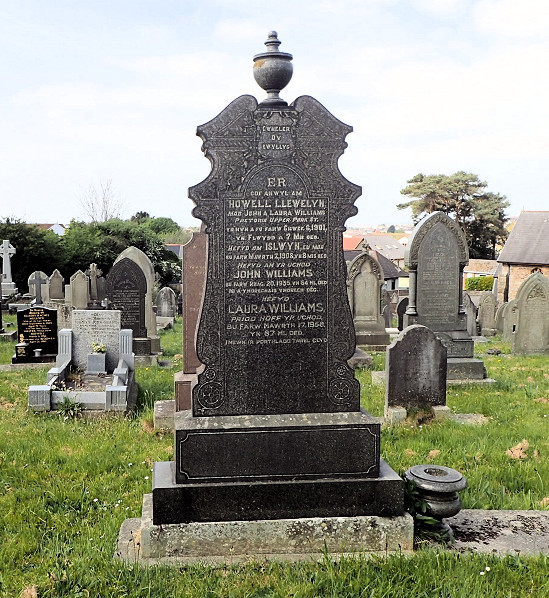
Despite John Williams's success in business, he was less fortunate in his health. About three years after the opening of his new shop, he suffered a series of attacks which saw him being removed to the Brunswick Nursing Home in Swansea. Despite this setback, he always exhibited a cheerful front. At the beginning of December, 1935 he underwent an operation making a brief recovery, but on Friday 20th December he died. He was interred in the Box Cemetery where his grave can be seen.. His funeral was witnessed by a large number of people from the town. [10]
Daniel Owen Williams
Dan was born circa 1910 and was involved in the business as a director of John Williams & Son. Like his father before him he was prominent in the commercial and social life of Llanelly. He was a former President of the Chamber of Trade and Commerce, a deacon at Capel Als and was connected with the Citizens Advice Bureau. His sporting interests led him to membership of the Llanelli Bowls Club and the Ashburnham Golf Club, where he was one of the oldest members. Under his stewardship the tailor and clothier shop in Market Street continued to thrive and had the reputation of being a high-class shop producing top quality clothes and attire in one of the busiest commercial streets in Llanelli.
In the summer of 1962 there was great excitement in the town as it played host to the Royal National Eisteddfod of Wales. In the same year Daniel Owen Williams decided to retire. On 28th July 1962 an advertisement appeared on page 7 of the Llanelly Star announcing…
John Williams & Sons will be Closing Down next Saturday August 4th
Although Daniel’s father was a fervent supporter of the Eisteddfod, Daniel must have felt that it was time to retire, and after more than thirty years the ‘high class’ tailor shop of Market Street closed its doors for the last time. Daniel retired and lived with his wife Sarah (‘Sal’), in Spowart Avenue, Llanelli where they resided until his death on 2nd October 1974.
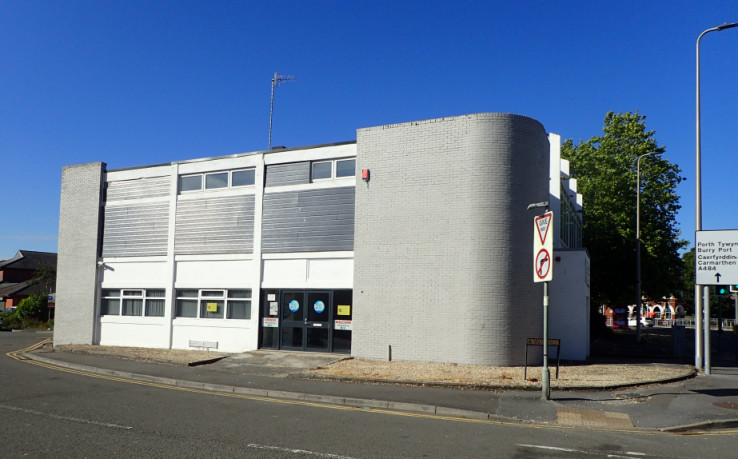
The closure of the shop at this busy time of the year signalled the decline of the "ladies & gents", hand made tailoring shops and clothiers that had dominated the high streets of the town. Llanelly could boast many, including W H Lewis, The Drapery Exchange, Morris The Realm, ‘Masters’ D. James & Sons, Robert Jones, D. Evans & Co., J. Lewis Harries, J. Butler & Hughes, Mackintosh & Jones, Puddy & Co, and The Regent, to name but a few. After its closure in 1962 the Art Deco building remained dormant for some time but eventually saw a number of uses, ranging from a home decorating supermarket known as Home Flair in the 1970s to its present use (2022) as a leisure and entertainment centre. The future of this iconic building now rests with the planners.
William Williams' Tŷ Gwyn Apostolic Church
 Variously known over the years as the Mission Hall, the Apostolic Church and lately the Tŷ Gwyn Community Church, William Williams' foundation has continued to serve the people of Llanelli. Its congregation expanded and outgrew the original building so that by 1989 it was extended and refurbished to form a new centre, listing its activities as including meals for the elderly, playschools for toddlers and a coffee bar for teenagers. The church continued to grow and on 20th February 2017 purchased a much larger property on two floors in the centre of the town called Brookfield House. This was built circa 1968 and was originally the Royal British Legion Club [11] The former Tŷ Gwyn Church in New Road was altered and became the home of Silcox Family Funeral Directors.
Notes & Citations
Berean Bible: Interlinear Bible text used for study purposes, based on the original Hebrew and Greek texts.
[1] Llanelly Mercury 25 January 1900 p3
[2] 1891 Census
[3] Llanelly Mercury. ibid.
[4] Llanelly Mercury 25 April 1901 p4
[5] Llanelly Mercury 2 March 1905 p7, 1906 Kelly’s Directory 1906 P498
[6] South Wales Press 3 August 1910
[7] Llanelly Star 19 Feb 1916 The Value of Advertising p4 c1
[8] Llanelly Mercury 3 April 1930 p8c1
[9] 1921 Census
[10] Llanelly & County Guardian 24 Dec 1935, Llanelly Mercury 26th Dec 1935, Llanelly Star 21 Dec 1935.
[11] Llanelli Star 13 April 1989.
Brookfield House information from the former owner, Mr P. Brookfield.
LCH0370