Colonel Joseph Griffiths R.A.M.C. C.M.G. (1863-1945)Eminent Surgeon, Pathologist and Founder of the
First Eastern General Hospital
by Wendy Morgans
Copyright Disclaimer under section 107 of the Copyright Act 1976. Any copyright material on this website is legally included as "fair use", for the purpose of historical research, study and education only.
Joseph Griffiths was born in the small rural village of Ponthenry (Pont-Henri), Carmarthenshire. The village lies in the centre of the Gwendraeth Valley.
Joseph had a very distinguished career in the Royal Army Medical Corps and went on to gain recognition for his work within the realms of medical science and history.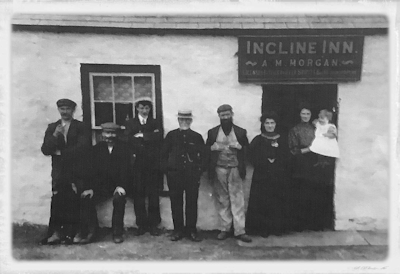
According to his birth certificate Joseph was born at ‘Incline’ in 1863 (1). There is some uncertainty as to whether this was the Incline Hotel, formerly the Incline Inn, or indeed the hamlet known as Incline (2). Joseph was the second son of David Griffiths, a master carpenter and his wife Sarah (née Everett). He was educated at Llanelly and studied medicine at Edinburgh University. In 1885 he graduated, with honours, as a Bachelor of Medicine and Master in Surgery. The university also awarded him the Murchison scholarship in clinical medicine (3). This was also the year in which he married Ethel Payne of Wixoe, Suffolk.
A career in medicine ensued and Joseph served for two years as assistant to the professor of pathology, W.S. Greenfield at Edinburgh before being appointed pathologist at Addenbrooke’s Hospital, Cambridge in 1887. His interest then turned to surgery and in 1890, whilst an assistant to the professor of surgery at Addenbrook’s, he attained a Doctorate in Medicine (4). At the doctoral graduation he was awarded a gold medal for achieving the highest possible distinction for his thesis (5). In the years that followed he continued to pursue and achieve even more academic qualifications.
In 1908 Joseph Griffiths held the rank of Lieutenant Colonel in the Territorial Army, and by the time war broke out in 1914 he had been selected as commanding officer, and promoted to the rank of Colonel (R.A.M.C.), of the First Eastern General Hospital (Territorial Force). He was successful in leading the campaign to set up the hospital – a large open-air field hospital, the first of its kind in Britain, at Nevile’s Court, Trinity College, Cambridge (6). This amazing complex sprang up like a mushroom on the former joint cricket field of King’s and Clare Colleges.
Described as a huge military field hospital covering ten acres on the present day site of Clare College’s Memorial Court and Cambridge University Library, it consisted of twelve 800 foot long huts, comprising twenty four wards with 1500 beds. It was, apparently a ‘state of the art’ hospital and between 1914 and 1919 it is estimated that over 70,000 patients had passed through its doors (7).
After 1919 a housing crisis meant that the huts, which had previously been used as wards, became council housing known as the Burrell’s Walk estate. The houses were subsequently demolished to make way for the building of the University Library in 1928 (8).
For his valuable contribution to the war effort in treating thousands of wounded soldiers returning from battle in France and Belgium, together with those affected by disease contracted abroad, Colonel Griffiths was awarded the C.M.G. (9) in 1918, presented to him by King George V.
Colonel Griffiths always retained his interest in pathology and after the war continued to work at Addenbrooke’s. Injuries to the bones and joints were his first interest but he also studied the surgery of urogenital disorders, in particular prostatic enlargement, and he made many contributions to professional journals. He set up a fine pathological museum at Cambridge and gave his private collection to the Hunterian Museum of the Royal College of Surgeons, Lincoln’s Inn Fields, London. In later years he became a keen huntsman and agriculturalist (10).
Colonel Griffiths died at Addenbrooke’s hospital, Cambridge in 1945. His wife Ethel survived him as did two sons and two daughters. A third son pre-deceased him, having died at the age of seventeen as the result of a tragic shooting accident.
A historical account of the First Eastern General Hospital published in 2012 (11) asks:
What manner of man was Griffiths? We know a certain amount from various obituaries and can draw conclusions from his writings, but we have no personal papers. He is described in the obituary in the British Medical Journal as ‘a tiny man physically, but of abounding energy and enthusiasm’. To the energy and enthusiasm should be added a remarkable talent for persuasion and persistence in getting his own way. His obituary in King’s College Annual Report for 1945 reports When war came, his inspiration, skill and energy were selflessly devoted to the troops ,so that the First Eastern General Hospital.....became famous. A host of patients were not only helped but cheered (as well as sometimes disciplined) by the infectious eagerness of the Commanding Officer.”
Pont-Henri can be justifiably proud of Joseph Griffiths who, from rather humble beginnings, went on to achieve such eminence as a surgeon, pathologist and pioneer in the field of medicine.
Notes & References
(1) Joseph Griffiths’s birth certificate- dated 17th May 1863
(2) Incline or inclined plane was a simple structure consisting of a sloping surface used for raising heavy objects. The incline at Ponthenry was used for raising coal.
(3) Established in memory of Charles Murchison (1830-1879) – eminent physician and former student at Edinburgh University.
(4) Plarr’s Lives of The Fellows – Royal College of Surgeons of England.
(5) Carmarthen Journal, dated August 15th 1890
(6) First Eastern General Hospital Memorial Fund -georgecalderon.worldpress.com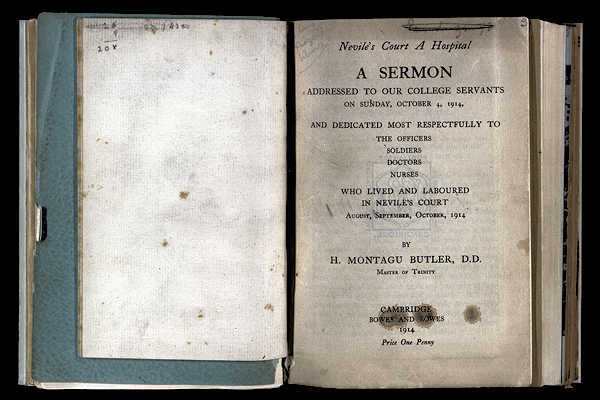
( 7) Trinity College Library - Treasure from the Collection
(8) “Nevile’s Court a Hospital...” The First Eastern General Hospital
Trinity College Library – Treasure from the Collection
(9) C.M.G. – Companion of the Order of St. Michael and St. George
(10) Plarr’s Lives of The Fellows – Royal College of Surgeons of England- GB/lives
(11) Guillebaud, Philomena From Bats To Beds To Books- Fern House Publishing, Cambridge, UK (2012)
lCH0403