Women in the Tinplate Industry: the Llanelli Workers’ Demonstration of 1890
Michael Williams © 2024
Introduction
The tinplate manufacturing industry went through three principal phases, each defined by location and technology (Minchinton, 1956, p.349). The industry originated in Saxony in the seventeenth century, based on the use of the tilt-hammer. By the nineteenth century, Britain was the major producer and South Wales was in the forefront with Llanelli in a very prominent position. Not surprisingly, it was dubbed ‘Tinopolis’ (Edwards, 1995). Technologically, the introduction of the rolling mill with a hot dip was crucial in this phase. In the third phase, the United States of America was the focal place and this was characterised by the use of the strip-mill cold-reduction process with tinning carried out by the electrolytic process. By the last decades of the nineteenth century the Welsh tinplate industry was in crisis. There were strong forces impacting on the tinworks: modernisation of machinery; adaptation to new markets; inflated prices for raw materials; and changed industrial relations were prominent among these. Workers were agitating for higher wages and better working conditions. Employers, generally, were reluctant to recognize the new unions. This article describes a Llanelli demonstration of tinplate workers that took place at this difficult time.
Context
Tinplate is a sheet of iron or steel covered with a thin layer of tin. The South Wales coalfield had a good supply of local coal and iron ore while tin could be obtained from mines in Cornwall. Clearly, there was a need for entrepreneurship and owners of tinplate works needed access to investment funds (Humphrys and Williams, 2022). Labour was also needed, predominantly men who could work in the hot, dusty and dangerous conditions that characterised the works.


The manufacturing process consisted of three stages. First the iron ore was smelted in a blast furnace to produce pig iron. Then the pig iron was converted into malleable wrought iron in a finery furnace, and finally reheated in a chafery furnace and hammered into bars under a tilt hammer. The iron bars were then ready for processing for tinplate manufacture or other uses” (Collins, 1971, p. 244)
The first tinplate works in South Wales were opened in Pontypool in 1720 and in Kidwelly in 1737. In the following century tinplate works were established in towns and villages across the South Wales coalfield. It has been estimated that at the peak of this period of rapid growth there were 288 in Glamorgan, 91 in Carmarthenshire and 57 in Monmouthshire (Lord Aberconway, 1927). The works that we are concerned with in this article was the Yspitty Tin Works that had been opened in 1869, having ten rolling mills. By 1874 the works had passed into the hands of Jacob Chivers and then his son Thomas Chivers. In 1890 the works was owned by J. Rushton Turnock who played a key role in the events at the works described below.
Many of the tinplate works were small in terms of the number of mills. By the 1880s it was clear that there was overproduction of tinplate in South Wales. Several issues were making continuous production difficult. The agricultural depression in Britain in the 1870s saw a fall in demand. At the same time, action by miners' groups had led to increased wages that led to inflation in the price of coal, a crucial raw material for the tinplate industry. Further, the depression in the countryside witnessed the migration of farm workers and others to the industrial communities. There was no shortage of unskilled labour. The importance of the latter can be deduced by the figures for different kinds of labour in a single tinplate works. At Kidwelly in the 1880s it was calculated that there were some 251 workers at the tinplate workers and they were divided into more than forty different skills plus the largest group comprising unskilled workers (Evans, 1986).
It is against this backdrop that we can view the changing picture of industrial relations in the tinplate industry. Craft unions grew out of the friendly societies that had protected the mainly welfare interests of their members.
In the tinplate industry Williams Lewis (Lewys Afan) had formed a union in 1871, under the title of the Independent Association of Tinplate Workers This union carried no friendly society benefits, and can best be described as a trade protection society” (Thomas, 1940, p.42.)
The title of the union was to change in 1887 to the South Wales, Monmouth and Gloucester Tinplate Workers’ Union but this title did not last and it was replaced by the Tinplate Workers’ Union.
Employers were much less organised as they confronted the growing unionism.. The majority of the tinplate works were owned by independent individuals. They received local petitions, letters and requests for negotiations from the Tinplate Workers’ Union though these were frequently ignored by the owners. Faced with changing circumstances in the industry local networks and alliances were formed. These considered such issues as wage rates, new technologies, changes in the prices and availability of raw materials and the prices of finished products.
Events
In October 1887 a letter written by J. Rushton Turnock, the owner of the Yspitty Tinplate Works, was published (South Wales Daily News) in which he referred to an agitators' meeting in Llanelli. Three years later, on September 26th 1890 the Carmarthen Journal and South Wales Advertiser published a lengthy article that described in detail a Llanelli demonstration. It estimated that nearly 2,000 tinplate workers had taken part. The marchers assembled in the People’s Park, Llanelli, before setting off for the Yspitty tinplate works located on the north bank of the River Loughor.
Led by a brass band and accompanied by some fife and drum bands, the marchers were marshalled by the union and they were joined by contingents of tinplate workers from tinplate works in Pontarddulais, Gorseinon and Loughor. The reason for the march was the employment of a small number of female assorters in the Yspitty works. Traditionally, the job in which the women checked the finished tinplate sheets for defects, had been reserved for men on the basis of age, seniority and merit.
The marchers passed the home of the owner of the Yspitty works, Mr John Rushton Turnock and the homes of some of the female workers. They gathered outside the Lewis Arms in Yspitty to listen to speeches delivered by union officials. After praising the marchers for their good behaviour, the officials were keen to emphasise that they did not object to the employment of women in tinplate works in principle. What they objected to was the employment of women as assorters. They passed a formal resolution requiring the female assorters to give up their employment and, in return, the union would pay them compensation.
A few days after the demonstration a letter was published from Mr. J. Rushton Turnock, the owner of the Yspitty Tinplate Works, in which he claimed that the published estimate of the number of marchers had been an exaggeration. He was pleased that the march was peaceful but he drew attention to a window of the home of one of the assorters that had been smashed. He wanted to emphasise that no negotiations had taken place or had been planned between the union and himself. He was grateful for the offer made by the union to compensate the assorters. Most importantly, he offered a robust defence of his decision to recruit and train female assorters. It is worth noting that he made no reference to the fact that employing women was advantageous for an employer since they received lower wages than men and they were not members of a trade union.
Meanwhile the union threatened to terminate employment contracts at Yspitty if the female employees had not been dismissed. On Saturday, October 25th 1890, it was reported, a meeting of tinplate men had been held where it was decided that all of the Yspitty workmen, some three hundred, would tender 28 days’ notices to terminate their contracts (South Wales Daily News, October 27th 1890 p.5).
Subsequently, the union also offered to pay £24 to each of the women by way of compensation. Attempts at negotiation failed and the men tendered their 28 days’ notices. The women also tendered their notices on the condition that they would receive compensation (South Wales Daily News, November 5th 1890 p.5).
The dispute rumbled on. By June 1891 the assorters had not been paid any compensation.(South Wales Daily News, June 22nd 1891). It would appear that the union was running short of adequate funds following its payment of relief funds to the striking workers at Yspitty.
The following year saw the Welsh tinplate industry in serious trouble.
“Before the autumn of 1892 it was estimated that about 10,000 tinplate workers were unemployed, either permanently or temporarily, as a result of the McKinley tariffs. A number of works such as the Gower Works, Penclawdd, the Old Lodge, Llanelly, the Gorseinon Works, Yspitty, Midland Works, Morriston, the old Ynyscedwyn, and the Llangennech Works were completely idle” (Thomas, 1949, p. 78).
Given these circumstances, plus Mr J. Rushton Turnock having a serious health problem, it is not surprising that the Yspitty Tinplate Works was put up for auction in 1893. It was bought for £5,100 by Sir John Jones Jenkins, who had spent many years working in local tinplate works. He later became Lord Glantawe. The works was to close in 1957 alongside dozens of other tinplate works.
Given the circumstances prevailing in the tinplate industry at this time, especially in Llanelli, it is not surprising to find emigration became increasingly attractive. The growing tinplate industry in the United States required skilled workers. Evidence of Llanelli emigrants for this can be found in passenger lists for emigrant ships, census returns for various locations, as well as in historical writing (Lewis, 2008 and 2023; Tyler, 2018; Williams, 2022).
However, American employers and workers were also engaged in conflict in the 1890s. The most notorious gun battle took place in July, 1892 at Homestead, located close to Pittsburgh Pennsylvania. This was the site of a Carnegie owned steel works. Strikers fought security agents and some twelve deaths were recorded and the strikers experienced a major defeat. A quite different episode directly involving a Welsh emigrant was the Hattie Williams affair of 1895. The Monongahela Tinplate Works in Pittsburgh wanted to train women to work in the works and engaged Hattie Williams, who had worked in tinplate in Wales to achieve this. The male tinplate workers protested at this (Jones and Lewis, 2007).
The role of women in tinplate production has been the subject of a number of studies including those by Owen-Smith, 1987, and Richards, 2022. A broader contextual study of the history of women in employment has been edited by John (2011). Much attention has been paid to the numerous Factory Acts that were passed in the nineteenth century, initially focused on textile workers and then broadening to a wider range of employment circumstances with special reference to the conditions experienced by women and boys.
Conclusion
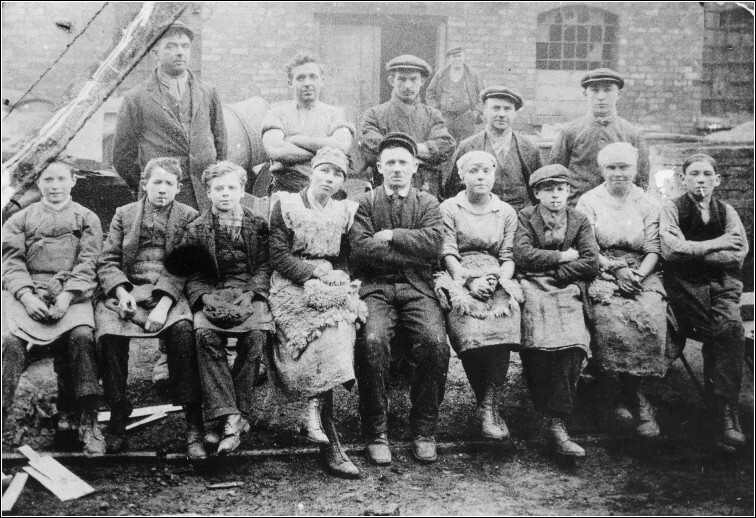
The 1890 demonstration and its aftermath highlight the difficulties encountered in the Welsh tinplate industry in the latter decades of the nineteenth century. These difficulties related to local circumstances and external forces. There was a need for investment in new technologies. Tinplate works had to adapt to changed markets and innovate with new products. The McKinley tariffs in the United States accelerated the need for modernisation and adaptation. Locally, unionisation of the workforce was growing and employers sought alliances in response. Employer paternalism was weakening as unions were recognised and negotiations took place. In this period women were being employed in tinplate works. They were engaged in a variety of processes including splitting, cleaning, polishing, assorting cold rolling and pickling. Within a decade of the 1890 Llanelli demonstration it was not unusual for larger numbers of women to be so employed. There is interesting photographic evidence of this in local publications, e.g. Davies, 2022; Russell, 2023. In Russell’s article there is a photograph taken about 1900 of twenty uniformed women employed in the John Player Tinplate Works.
Notes & Citations
I wish to acknowledge the source of newspaper references, the website of the National Library of Wales, Welsh Newspapers Online: newspapers.library.wales/
[a] Collins, G. (1971) Industry: The technological background, Ch. XVII in Balchin, W.G.V. (ed.) Swansea and its Region, Swansea: University College of Swansea.
[b] Davies, B. (2022) Dafen Tinplate Works, Llanelli; Llanelli Community Heritage website.
[c] Edwards, J. (1995) Tinopolis: Aspects of Llanelli’s Tin Trade, Llanelli: Llanelli Borough Council.
[d]Evans, M. B. (1986) An industrial workforce - Kidwelly tin workers 1881, Carmarthenshire Antiquary, 20-22, 51-58.
[e]Harvey Jones, W.M. (1907) Welsh settlements in Ohio, Ohio History Journal, 16 (2) 194-227.
[f]Humphrys, G. and Williams, M (2022) Jacob Chivers (1815-1883): a South Wales Entrepreneur and Philanthropist, Llanelli Community Heritage website.
[g[Jenkins, P. (1995) Twenty by Fourteen: A History of the South Wales Tinplate Industry 1719-1961, Llandysul: Gomer Press.
[h]John, A.V. (ed) (2011) Our Mother’s Land: Chapters in Welsh Women’s History, 1830-1939, Cardiff: University of Wales Press.
[i]Jones, B. and Lewis, R.L. (2007) Gender and transnationality among Welsh tinplate workers in Pittsburgh: the Hattie Williams affair, 1895, Labour History, 48 (2) 175-194.
[j]Lewis, R.L. (2008) Welsh Americans: A History of Assimilation in the Coalfields 1840-1920, Chapel Hill: University of North Carolina Press.
[k]Lewis, R.L. (2023) Welsh Immigrants and the American Age of Steel, Pittsburgh: University of Pittsburgh Press.
[l]Lord Aberconway (C.B.B. McLaren) (1927) Ch XIX The tinplate and the non-ferrous metallurgical industries of South Wales, in The Basic Industries of Great Britain, Coal, Iron, Steel, Engineering, Ships: An Historic and Economic Survey, London: Ernest Benn Ltd.
[m]Minchinton, W. E. (1956) The diffusion of tinplate manufacture, Economic History Review, 9 (2) 349-358.
[n]Minchinton, W. E. (1957) The British Tinplate Industry: a History, Oxford: Oxford University Press.
[o]Owen-Smith, S. (1987) Women in the tinplate industry, Llanelli, 1930-1950, Oral History, 15 (1) 42-49.
[p]Pride, E. (1959) Tinman’s Progress, The South Wales Tinplate and Steel Sheet Industry in 3 Centuries, Swansea: University College of Swansea.
[q]Richards, A.J .(2008) Tinplate in Wales, Pwllheli: Llygad Gwalch Cyf,
[r]Richards, J. (2022) Opening the Tin: Women in the South Wales Tinplate Industry c. 1880s-1940s. Dissertation for the Open University module AA329 The Making of Welsh History. Open Research Online.
[s]Russell, P. (2023) The Player Family, Clydach and District through the Ages, Vol. 2
[t]Thomas, P.S. (1940) Industrial Relations: A Short Study of the Relations Between Employers and Employed in Swansea and Neighbourhood, from about 1800 to Recent Times, Social and Economic Survey of Swansea and District, Pamphlet No. 3, Swansea: University College of Swansea.
[u]Tyler, R.L. (2018) Migrant culture maintenance: the Welsh experience in Martins Ferry, Belmont County, Ohio, 1900-1940, Ohio History, 125 (1) 70=94.
Williams, M. (2022) John Charles Williams (1876-1936): Kidwelly-born American Industrial Magnate and Philanthropist, Llanelli Community Heritage website.
Copyright © Michael Williams 2024
