Bynea Rail Disaster 3rd October 1904
On Monday 3rd October 1904 a train on its way from Milford Haven to London Paddington left five people dead, and dozens more injured. The accident occurred on the railway line which runs over Bacus Marsh, within a few hundred yards of Bynea Station, and a village known as Cwmfelin.

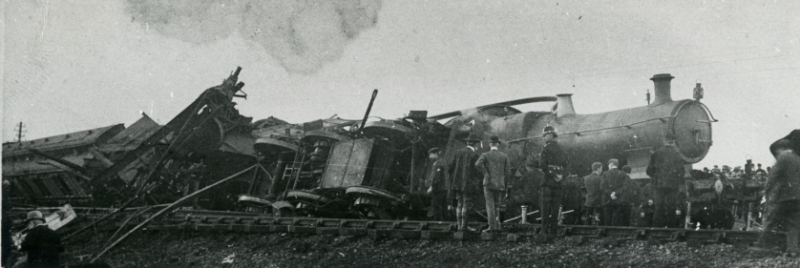

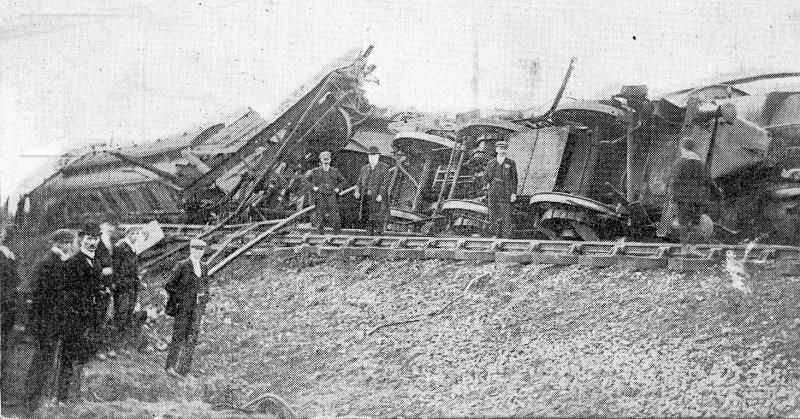

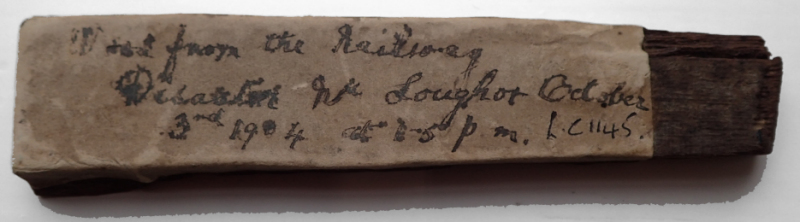
The Mail Express which left Milford Haven at 10.35 am passing through Llanelly at 1.05 pm had proceeded without incident. Nearing Loughor Bridge the entire train went off the rails. The two engines in front overturned, falling down the embankment along with all three carriages. The driver, the banker engine driver, and three passengers were killed with many more being gravely injured.
People nearby on hearing the sound of the crash rushed to the scene. Every doctor in the vicinity was called. Dr Abel Davies from Gowerton, among others, arrived quickly, and the nearby hospitals of Llanelly and Swansea were told to prepare for casualties.
One of the first local people on the scene was Mrs Williams of Yspitty House, Bynea. Mr William Parry, a native of Fishguard, who escaped alive from the crash, had torn up his shirt, for use as bandages, and was thanked by Dr Hughes of Llanelly for his work
People on the train at the time recalled the moment of impact when the carriages overturned. All were shocked and appalled by the shrieks and cries of the terrified passengers. Afterwards they recalled the gruesome scenes that followed.
The driver of Engine 1674, Mr J. Lloyd of Whitland, then living in Llanelly, was killed. The driver of the second engine, Mr J. Thomas, survived, but Mr John Harries, fireman of the banker engine died shortly after admission to hospital. Mr Oliver Stallard of Bristol travelling from Pembroke Dock to Bristol was also killed and his body was conveyed to the Plough Inn at Bynea.
Two months later on December 23rd 1904 a formal accident investigation still could not come to a firm conclusion as to why the train was derailed. The line at this spot was very straight for some considerable distance and there was a low embankment for two miles. Suddenly, the carriages had jarred, and the three carriages hurled over the embankment. However they did find that secondary causes including poor rolling stock stability, and an inadequate speed limit as well as excessive speed on the day had contributed to the accident.
The Llanelly Coroner also commented that if it hadn’t been for the fact that injured passengers, the local doctors and authorities, as well as the people from the community, had been so efficient, the casualty rate would have been much higher.


Notes and Citations
- Llanelly is an anglicised form of Llanelli used until 1966
- Sources: Contemporary local newspaper reports including the Cambrian of 7th October, 1904
- Images courtesy Llanelli library
- Lat: 51.669620 Lon: -4.120361 part way between the Bynea rail junction to the north and Loughor bridge
- Blue Plaque photos by Carole Anne Smith
LCH0382