Pembrey Dynamite Explosion of 1882
Most visitors to Pembrey Country Park will leave having acquired the knowledge that the park was once the site of the manufacture of explosives during both world wars. Some will also have learned of the price paid in human lives through various accidents which occurred here during that time. However, few will have heard of an earlier tragedy which happened within the confines of the park in November 1882.
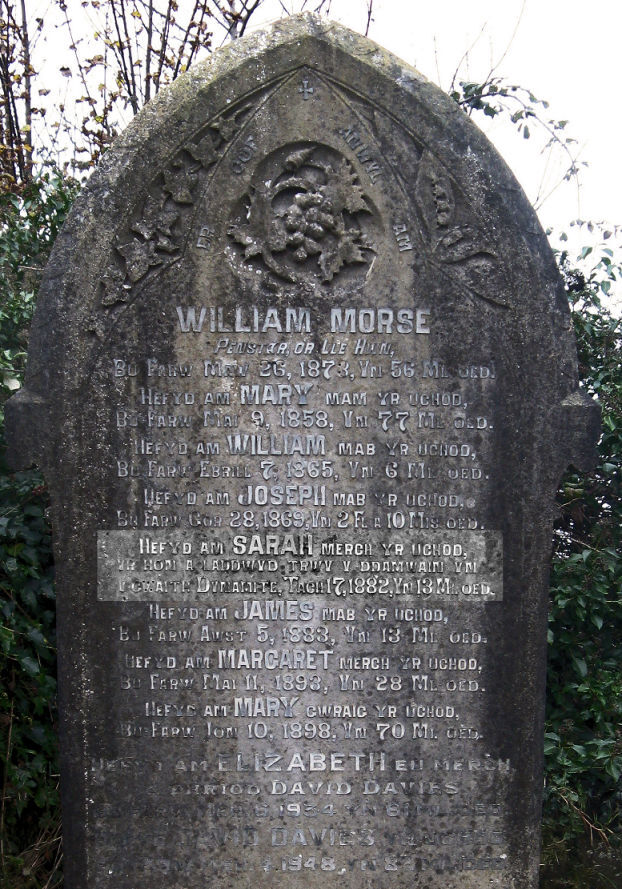
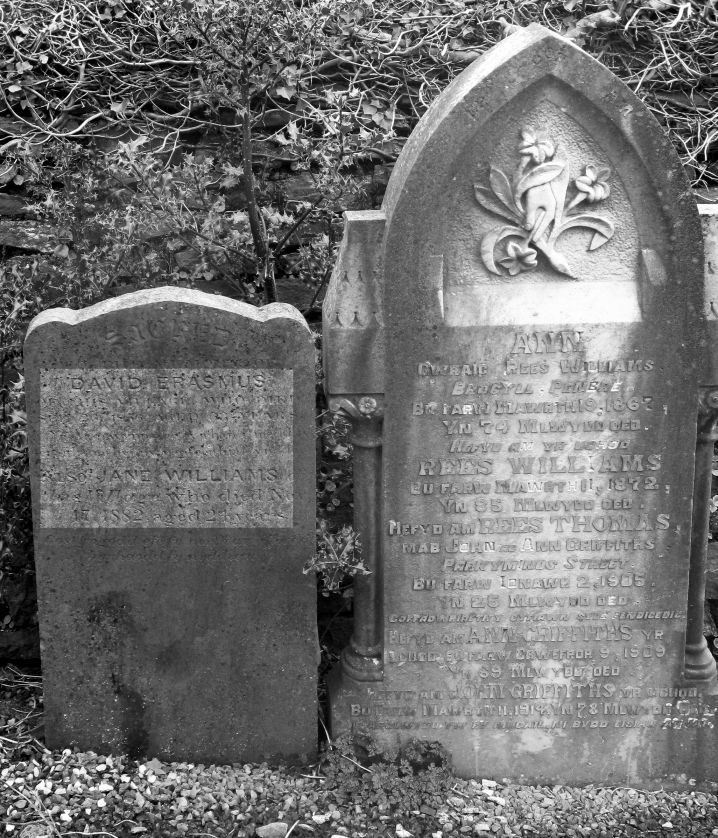
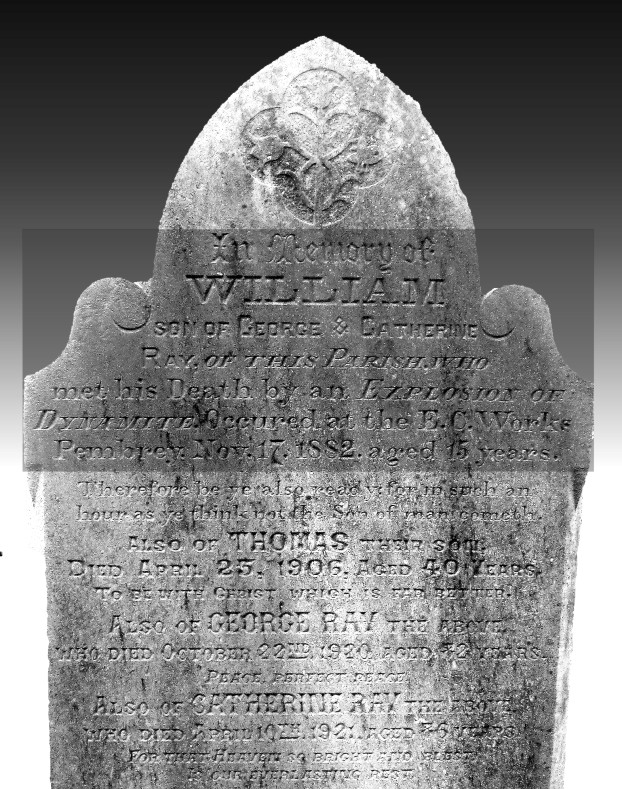
Photographs of some of the graves of those killed in the explosion

Background information
In 1881 the Explosives Company Limited of London had constructed and started to operate a dynamite production plant in an area known locally as the Burrows, about two miles south-west of Pembrey village, and roughly near the site of the modern-day ski centre in the country park (Lat: 51.677549 Lon: -4.301034)
To export the finished dynamite a tram line was built to link up with Pembrey harbour. The 165 acre site contained a number of buildings; 52 in total. Most were constructed of wood due to the hazardous nature of the product being processed. To mitigate the effect of any explosion, the roofs to these wooden huts were of a slightly weaker construction than the timber walls. The abundant sand available was put to good use in building embankments around each hut, projecting any blast upwards out of harm's way. Approximately one hundred people were employed at the site, about 70% being young girls and boys.
Shed #12 was typical of those wooden huts and, in November 1882, was being used to wash and thaw lumps of dynamite to make it more malleable for filling cartridges. In the cooler autumnal weather dynamite had a tendency to harden and become brittle, not too dissimilar to modern-day plastic. The process of thawing involved immersing the dynamite in trays of warm water. Young girls were generally given this task, while boys ferried the raw dynamite and warm water from nearby taps to the doorway of the hut. There were strict rules governing this operation, with only two girls at a time allowed to carry out the thawing process. The boys were not allowed to enter the hut, but had to deposit their loads at the doorway; the boys usually wore hob-nailed boots. The floors of the huts were also covered with sand as an added precaution against explosion.
The work was potentially dangerous and the hours long - twelve-hour days. However compared to other occupations the wages were relatively high: a young teenager could earn up to two or three shillings a day. The high wages paid by the company had even caused a local domestic staff shortage.
The explosion
At around 11:45 am on 17th November 1882 a loud explosion rocked Pembrey village. So intense was the explosion that villagers fled their houses fearing that the noise was caused by an earthquake. However, after a short time everyone's attention was drawn to the dynamite works out on the Burrows. At the location on which had once stood shed #12 there was a scene of utter devastation. The hut itself was now matchwood and seven young people lay nearby. Four young souls were merely a collection of body parts, while three were mortally injured and in desperate need of help.
Within a few minutes, Sarah Morse aged just 13, drew her last breath. William Ray and Mary Hughes had both received life-threatening injuries and were suffering from the effects of shock. Complaining of feeling cold, they were brought indoors and awaited the medical help of local doctor, Owen Williams, who arrived some thirty minutes later. Young William Ray, aged 14, passed away a few hours later in the arms of his father who had been allowed inside the plant to see his son. By four o'colck Dr. Henry Barclay had arrived from Llanelly, but nothing could be done for the remaining casualty, Mary Hughes, who passed away that evening.
Outside, around the scene of the explosion, items were left in situ, pending the future inquiry. Wooden stakes marked where each of the seven young souls had been found. Evident, on what had been the hut floor, were two craters, one larger than the other. A clue to what exactly had happened at shed #12 perhaps.
The funerals
On Sunday, seven coffins were brought up to the village via the tram line. Despite the rain many people turned out to accompany the cortege. At its head were children from the various Sunday schools of the area.
The following day the funerals of all seven took place at the various burial grounds in the village. The biting cold wind, cloud and slowly tolling church bells in the background adding an extra sense of sadness to the whole scene. First to be interred was John Jones at St.Illtyd's churchyard. The cortege then moved on to Hermon Chapel, where Sarah Morse of Pen Star, the youngest of the seven, was buried. Jane Evans was laid to rest at Tabernacle, Burry Port, before the mourners walked back to Bethel Chapel, Pembrey for the funerals of the other four: William Ray, Jane Williams, David Erasmus and Mary Hughes. At the graveside of the latter, one of the mourners was her grief-stricken husband-to-be. By now the light had started to fade and the rain became heavier, a truly tragic day in the village's history.
The inquest
Almost immediately an inquiry was held into the cause of the explosion. By coincidence only a few days prior to the explosion of 17th November, a smaller explosion had occurred within the works (Saturday 11th), the sole casualty being a boy who was slightly burned. Due to this previous incident, the dynamite works had been the subject of a safety-related debate in the House of Commons the following Tuesday (14th Nov). With deepening concerns about the company and this latest explosion at the works, the Government despatched its Inspector of Explosives, Major Majendie and two of its chief scientists, Professors Abel and Dupre, to help with the inquiry. Also summoned to the inquiry were the works manager, Ernest Spon, and undermanager, Mr. Thomas. Chairing the inquiry was coroner James Rowlands.
During eleven sittings, held over many weeks, the jury heard from witnesses countless aspects of the procedures and protocols at the works, but foremost in everyone's mind was the actual cause of the fatal explosion of 17th November.
Evidence from some employees suggested that many misdemeanours had taken place at the site. Two alarming examples being that boys were seen to be warming their hands in the warm water trays used for thawing the dynamite earlier on that fateful day, and that a number of girls, other than the two authorised to be in shed #12, had been seen 'gossiping' within the shed: both violations of the strict 'two-persons rule' governing the thawing hut.
As to the actual cause of the explosion, Professor Abel, after conducting many experiments with samples of the actual dynamite produced at the works, concluded that the most likely cause was thawed/warmed-up dynamite being dropped onto a tray (possibly on the floor) from a short height, causing a small explosion. A chain-reaction then led to a greater explosion (larger crater) seconds later.
Three other theories quoted by professor Abel were:
1. A small brass scoop used to fill cartridges, caused high impact friction in the thawed/warmed dynamite.
2. Crystallisation of nitro-glycerine particles formed on the outside of the dynamite being processed.
3. Pieces of dynamite may have adhered to the boots of the boys, striking the bottom of a table in the hut.
In his summing up coroner James Rowlands made many recommendations: two prominent improvements focused on the process of thawing dynamite and the need for it to be undertaken in future by mechanical means, such as heated air blowers, rather than by manual labour; the other was that the ages of employees should be verified more stringently, the minimum age for work involving explosives, under the Explosives Act, being set at 16 years.
The actual cause of the fatal explosion was never truly established, only the two girls authorised to work in shed #12, Jane Evans and Jane Williams, will have known what exactly happened that day: They took that secret with them to the grave.
The visit
On 20th November 2021, an anniversary of the funerals, the author re-traced the steps of the mourners through Pembrey village and located five headstones of the seven young casualties. Standing a few feet in front of William Ray's grave at the elevated site of Bethel Chapel, the scene of the explosion at the Burrows two miles away comes into view.
The casualties
- Sarah Morse (13 years) Pen Star. Buried Hermon chapel. ILL_6016
- John Jones (13 years) Glo Caled. Buried St.Illtyds. (No headstone found)
- David Erasmus (14 years) Village. Buried Bethel chapel. (No headstone found)
- William Ray (15 years) Derwydd. Buried Bethel chapel.
- Jane Evans (16 years) Fald. Buried Tabernacle chapel, Burry Port.
- Mary Hughes (22 years) Village. Buried Bethel chapel.
- Jane Williams (24 years) Sandy Row. Buried Bethel chapel.
Notes and Citations
- Llanelly Guardian newspaper
- Llanelli library's micro-film collection.
- Llanelli library photos are the ILL numbers
LCH0385